How to Choose Data Center LED Displays: A Practical Selection Checklist
In 7×24 mission-critical environments like data centers and command centers, a wrong display choice leads to high maintenance costs. With specs from P0.7 to P3.91 and SMD, COB, GOB packaging options, what should buyers evaluate? Based on an interview with Stonbel's manager and real project data, this checklist covers pain points, solutions, and quantified results for data center LED displays.
Q1: Should data center LED displays use COB or GOB packaging?
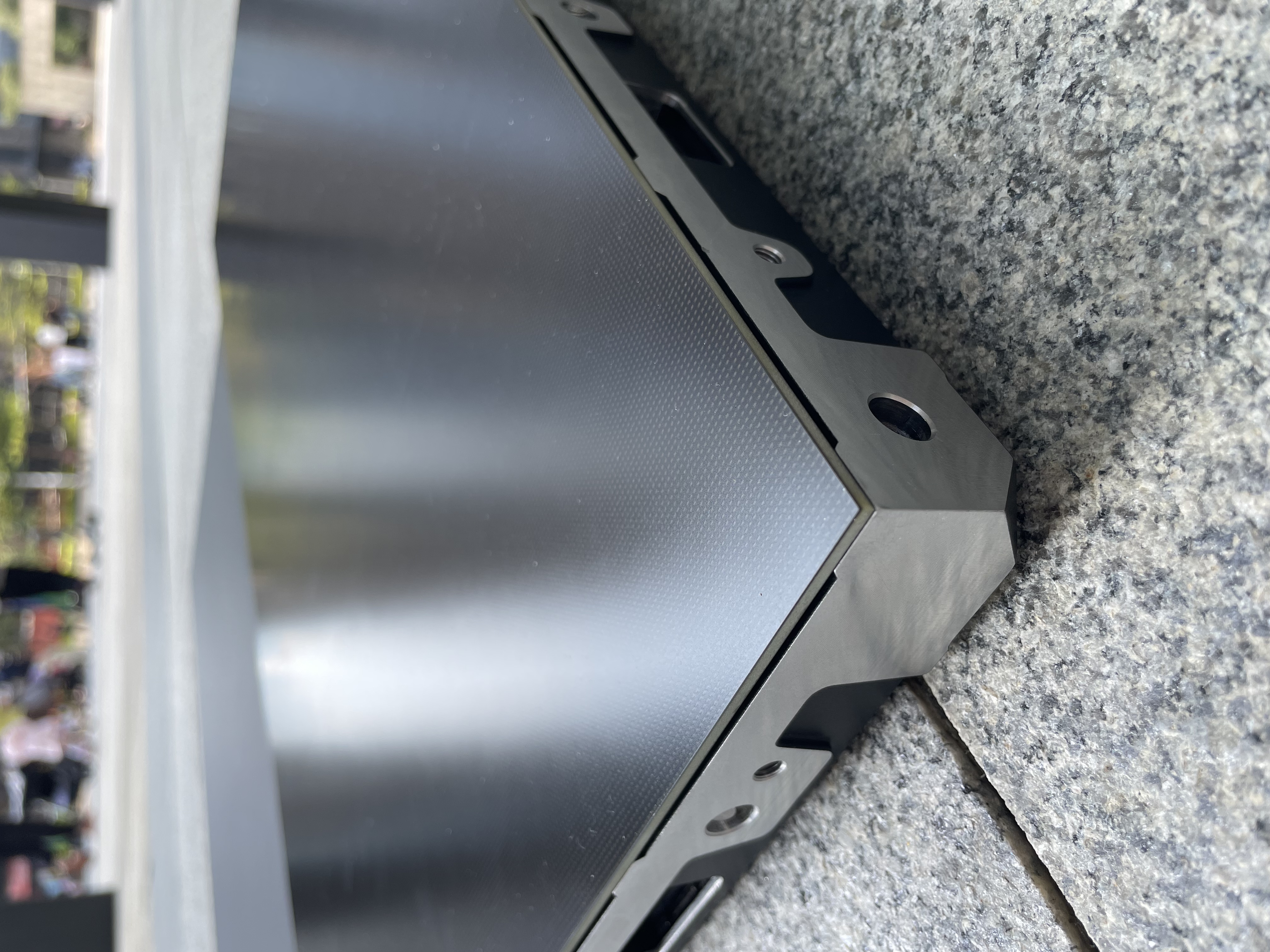
A: It depends on whether image quality or protection is the priority. COB bonds chips directly to the PCB with no lamp bead structure, minimum pitch down to P0.7, fine image quality without graininess—suited for high-end command centers and classified scenarios requiring seamless splicing and image quality, as in the Hunan Military project using COB P1.25. GOB fills transparent resin over SMD lamp beads, reaching IP65+ protection at lower cost than COB—suited for hospital corridors, industrial workshops, and transport hubs with frequent contact and complex environments, as in Zhengzhou East Station using GOB P2.5. If budget allows and ultimate image quality is the goal, choose COB; if high protection and cost-effectiveness matter equally, GOB is more suitable.
Q2: How much do refresh rate and grayscale affect data center LED display performance?
A: The impact shows directly in dynamic images and color transitions. Low refresh rates cause scan lines on camera and lag in dynamic trajectories. The provincial Emergency Management project uses 7680Hz ultra-high refresh rate—smooth images without ghosting, meeting 4K ultra-HD signal input needs. For grayscale, 22bit enables smoother color transitions without losing dark detail—critical for situational maps and logistics trajectory maps requiring fine discrimination. NTSC ≥130% ensures accurate color reproduction; military-grade color calibration achieves brightness and chroma consistency ≥99%. When selecting, make refresh rate, grayscale, and color gamut mandatory specs.
Q3: How do data center LED displays ensure 7×24 stable operation?
A: The key lies in thermal design, packaging reliability, and O&M mechanisms. SMD lamp beads are independently soldered with good heat dissipation; COB has no lamp bead structure, reducing partial blackouts from bead failure; GOB sealing layer resists dust and moisture. The provincial Emergency Management project uses industrial-grade thermal design for 7×24 continuous operation, with annual failure rate below 0.2%. The SF Express HQ system runs stably year-round, cutting daily O&M cost 62%. Additionally, 31 provinces with resident service points and 7×24 dedicated O&M support ensure rapid fault response. When selecting, require suppliers to provide thermal solutions and O&M response commitments.

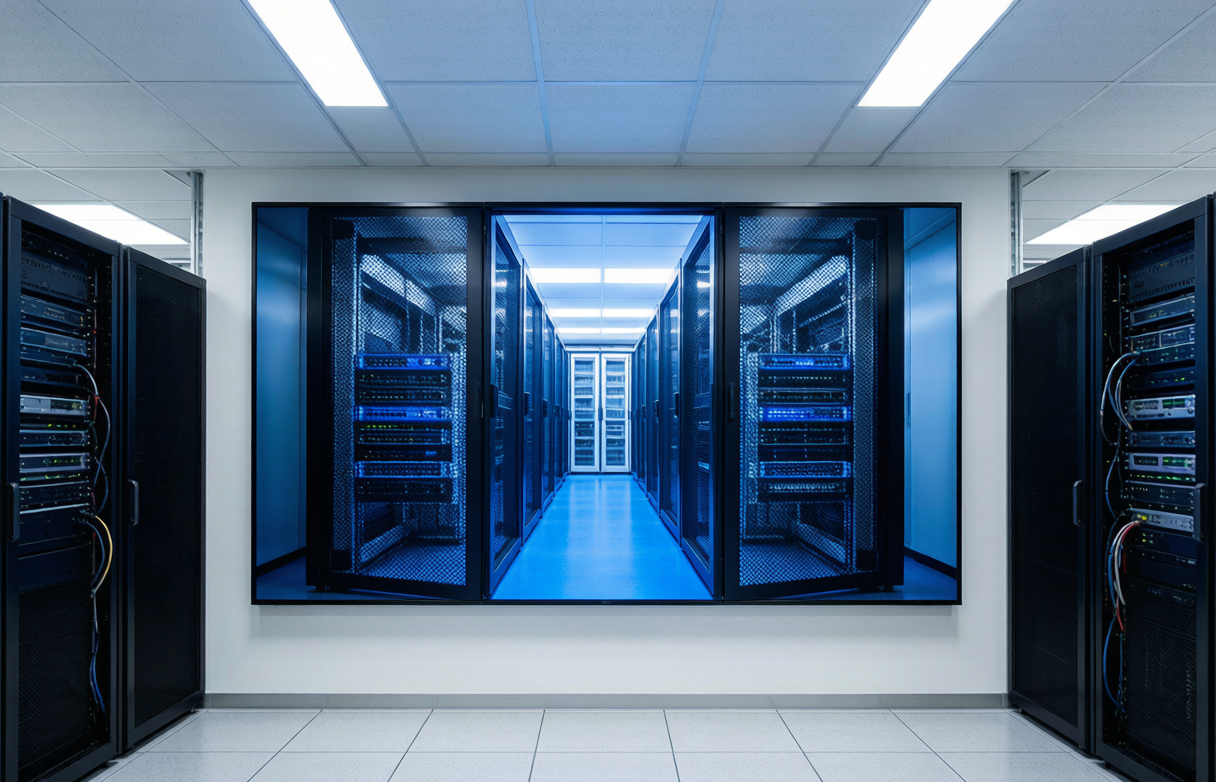
A practical data center LED display checklist answers three questions: image quality, protection, and lifecycle service. Real projects show COB P1.25 seamless splicing, COB P1.5 multi-signal linkage, and 7680Hz high refresh with 64 signal inputs. SMD, COB, and GOB each have boundaries; pixel pitch, refresh rate, grayscale, and IP rating must match site needs. Stonbel, an LED/LCD display manufacturer, supports data center LED display projects from custom production to operation with a 31-province service network and military/classified qualifications. The key is translating specs into business language.