From P0.7 ultra-fine pitch to IP65 high protection, from 7680Hz high refresh rate to 22-bit grayscale, every parameter reflects real airport scenario demands. This article analyzes cases including Hangzhou Metro Command Center and Shanghai Planetarium, examining hidden costs and long-term maintenance pain points most easily overlooked during bidding, helping buyers establish an evaluation system balancing short-term budget with full lifecycle value.
Case Background: Demanding Airport Display Challenges
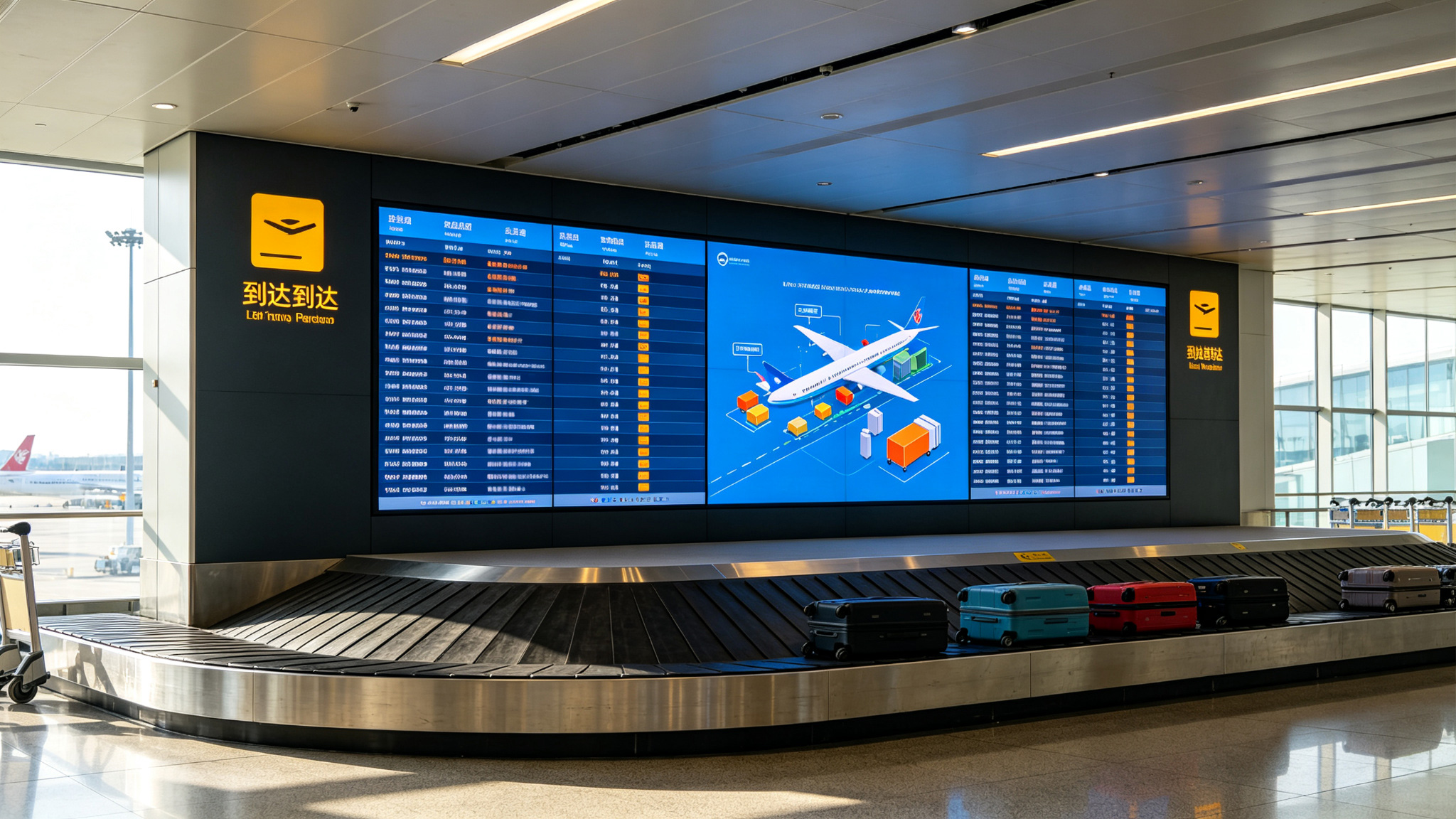
Airport LED displays are critical information infrastructure, and their procurement is a systematic project involving technology selection, qualification review, installation, and maintenance. In a major hub airport's display upgrade, handling over 150,000 daily passengers across 3 terminals, the existing mixed-brand system suffered from color inconsistency and high failure rates. The tender mandated 7×24 operation, sub-30-minute fault recovery, and compatibility with existing flight information systems. Stonbel won the project with a focus on 'zero-fault operation' and 'rapid response'. The airport required any screen failure to be resolved within 30 minutes to prevent passenger delays. Stonbel leveraged its service network across 31
Implementation: 45 Days from Production to Delivery
During acceptance testing, the displays achieved a 7680Hz refresh rate, 22-bit grayscale, and NTSC≥130% color gamut, delivering superior color accuracy. High-speed flight information appeared flicker-free on camera, suitable for broadcast and passenger phone videos. Outdoor screens met IP65 protection, with a lifespan exceeding 100,000 hours. The project was completed in 45 days (20 for manufacturing, 25 for installation), 25% faster than the airport's 60-day plan. Stonbel deployed COB technology for 120㎡ of P1.2 fine-pitch displays above check-in islands and security areas. COB's chip-on-board design offers a seamless, particle-free image and IP55
Technical Highlights: Hybrid Packaging & Smart O&M
Airport projects require diverse display solutions. Stonbel deployed a hybrid strategy using SMD, COB, and GOB technologies. SMD was used for outdoor screens above P2.5, offering excellent heat dissipation and brightness up to 8000cd/㎡. COB was used for indoor fine-pitch screens below P1.2, providing high pixel density and a seamless image for command centers. GOB, a protective coating for SMD screens, achieved near-COB protection at lower cost, ideal for crowded waiting areas. For signal processing, the system integrated flight information, weather radar, video surveillance, and emergency broadcast feeds. Stonbel installed multi-screen controllers supporting 4K/1080P, 5G/WiFi/4G connectivity, and seamless signal switching. The O&M platform monitored temperature, humidity, brightness decay, and pixel faults in real-time,
Outcomes & Insights: The Evolution of Airport Displays
This project highlights a trend: airport LED displays are evolving from passive information boards to intelligent interactive terminals, integrating facial recognition, predictive flight updates, and indoor navigation. Stonbel's experience with hybrid COB/SMD deployment, multi-signal integration, remote management, and rapid delivery provides a replicable model. Buyers should evaluate a supplier's overall solution capability and long-term service commitment, not just hardware price. The total lifecycle cost of 7×24 infrastructure far exceeds the initial purchase. Choosing a partner with manufacturing capabilities, proven case studies, and a robust service network is
Q1: How to choose the right pixel pitch for airport LED displays?
A: Pixel pitch depends on viewing distance and required detail. For close-up areas like check-in islands (2-3m), we recommend COB fine-pitch products (P0.7-P1.2) for ultra-high definition without a visible pixel grid. For central hall screens viewed from 3-5m, P1.5-P2.5 balances clarity and cost. For outdoor viaduct or tarmac screens viewed from over 5m, SMD outdoor screens (P4-P6) offer better value with brightness up to 8000cd/㎡. Consider installation height; an 8m-high screen typically has a 4-8m viewing distance, suitable for P2.5, while a 20m-high tower screen requires P6 or larger with ultra-high brightness. Request simulation renderings based on actual installation positions and cross-check with civil aviation display design standards. Also, ensure pixel density matches video source resolution to avoid blur. Stonbel offers free consultation to recommend solutions based on your specific space and content.
Q2: What ingress protection (IP) rating is required for airport LED displays?
A: IP ratings must match the installation zone. Indoor areas (check-in, waiting, baggage claim) require at least IP40 for dust and touch protection, plus anti-static properties. Outdoor areas (viaducts, tarmac, tower vicinity) must meet IP65 or higher to withstand rain, dust, and salt spray. Stonbel's GOB coating enhances SMD screens to IP65+ at a lower cost than COB, protecting against moisture and short circuits. COB's inherent structure easily achieves IP55, ideal for high-end indoor command centers. Request third-party test reports specifying conditions (water pressure, duration, dust concentration). For coastal airports, require neutral salt spray testing (e.g., ASTM B117, 500+ hours) to ensure longevity in marine climates. Also, consider vibration resistance, especially near runways or in seismic zones; request vibration test reports to ensure structural integrity.
Q3: What qualifications should airport LED display suppliers possess?
A: Suppliers must meet several criteria: 1) Product Certifications: 3C, CE, FCC, ROHS for market access. 2) System Certifications: ISO9001 (Quality) and ISO14001 (Environmental) for stable processes. 3) Specialized Qualifications: For secure areas (e.g., ATC, security rooms), suppliers need military or classified information system integration qualifications. 4) Industry Standing: Proof of top-10 ranking in China's LED industry, provincial-level high-tech enterprise status, or innovation awards. 5) Case References: Contracts or acceptance reports from airport, rail, or large venue projects within 3 years. Stonbel's clients include Huawei, Peking University, and PUMCH, demonstrating complex delivery capability. 6) Service Network: Evidence of local service points or
Airport LED display procurement is a highly specialized systematic project covering technical parameters, qualification review, installation processes, and maintenance services. Airport owners should abandon low-price bidding mindsets and adopt multi-dimensional evaluation including technical specs, industry qualifications, case references, and service networks. As a source manufacturer, Stonbel offers P0.7-P10 full pitch coverage, service points across 31 provinces, and 3C/CE/FCC certifications, fully capable of serving high-end airport projects. Stonbel is committed to advancing China's airport information display standards alongside owners, integrators, and contractors.