Based on three real projects—Chengdu Tianfu International Airport Cargo Monitoring Center, Suzhou Industrial Park Smart Manufacturing Exhibition Hall, and Sun Yat-sen University Smart Classroom—this article reviews the selection logic and performance of conference all-in-one displays under complex ambient light. It focuses on how the 300-1000cd/m² brightness range and NTSC≥110% color gamut address different lighting conditions, offering measurable reference for industry users. Combined with Stonbel's full product matrix and service capabilities, it helps readers build a complete decision framework from parameter understanding to scenario deployment.
Case Background: The Overlooked Display Pain Point of Ambient Light Variation
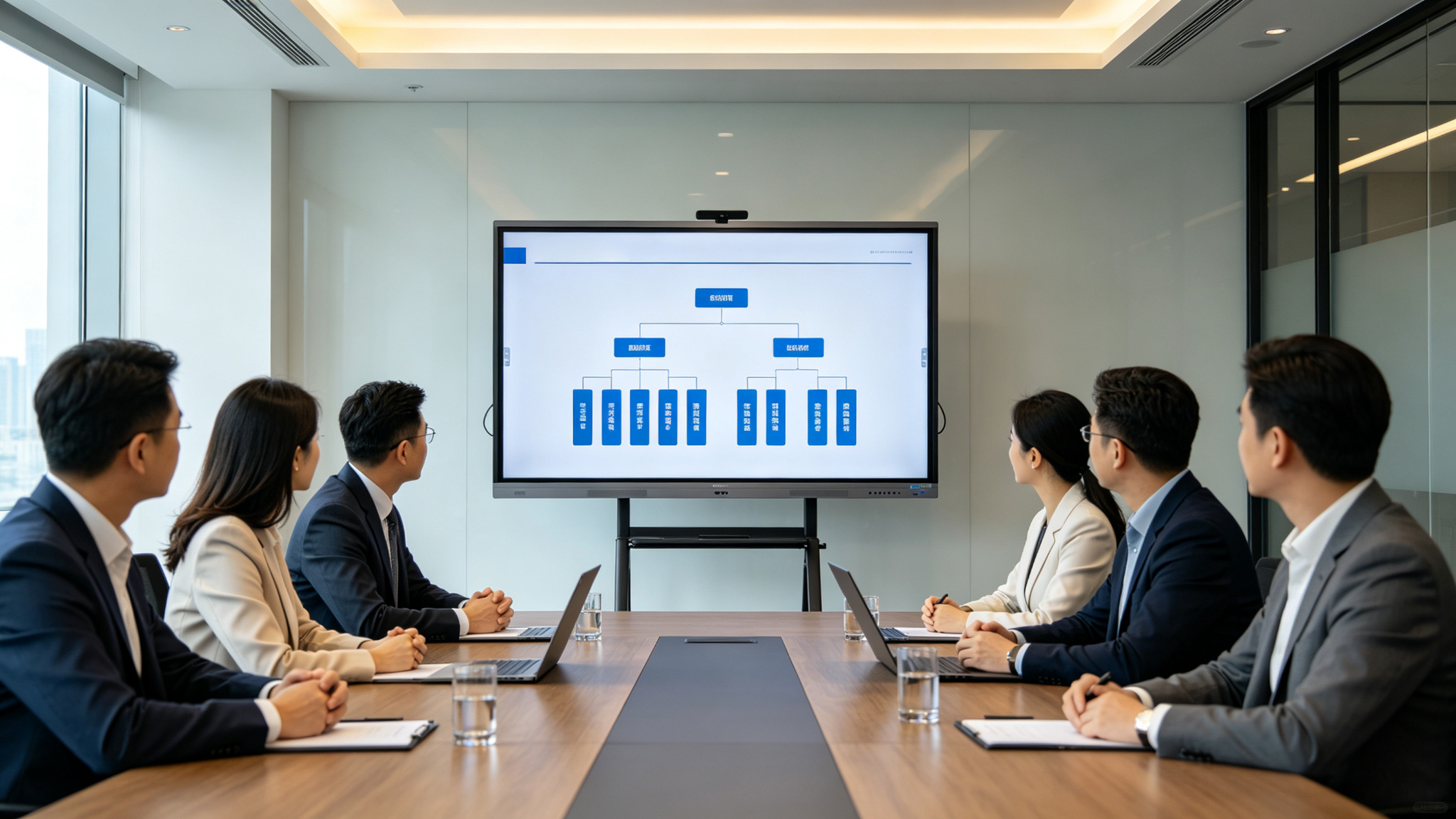
Industry trends show that conference all-in-one machines have evolved from simple display tools into devices with integrated environmental sensing. Stonbel products support ambient light sensors for automatic brightness and color temperature adjustment, paired with 16-bit grayscale output to maintain smooth grayscale transitions under varying lighting conditions. This synergy between hardware specs and software algorithms is key to solving ambient light adaptation. For government and enterprise users, seamless integration with existing office systems is also critical—rich interfaces and expandability protect prior investments. For
Implementation Details: Differentiated Deployment Strategies for Three Scenarios
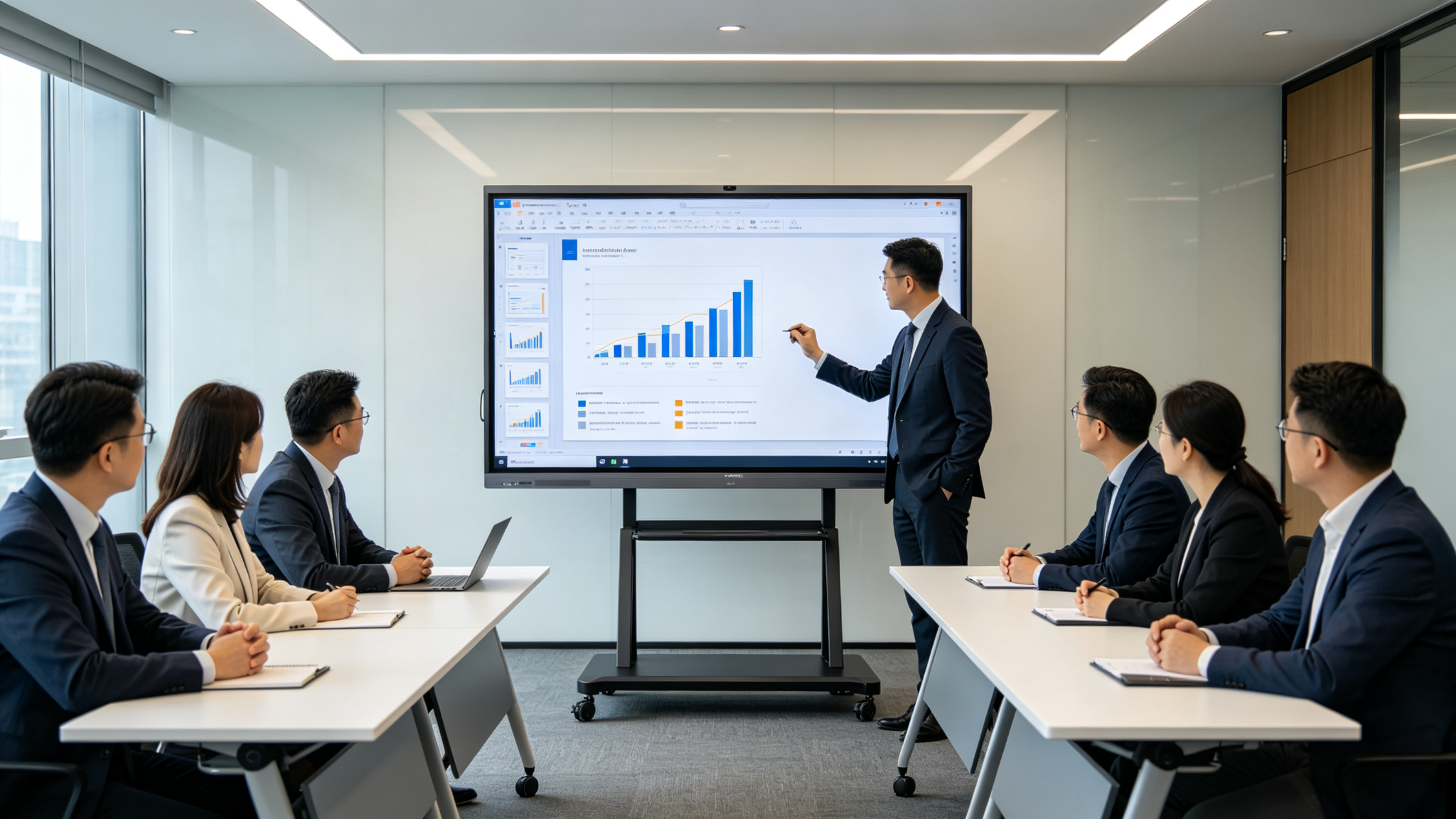
During project rollout, Stonbel customized a combined solution for the Suzhou Industrial Park exhibition hall, integrating LED fine-pitch seamless video walls with conference all-in-one machines, featuring industrial park data visualization modules, dynamic enterprise info rotation, and one-click investment policy queries. This combination leverages the LED wall's brightness advantage for long-distance viewing (pixel pitch P5, brightness 300-1000 cd/m²) while utilizing the touch convenience of the conference all-in-one for close interaction. For digital training in chain retail, Stonbel equipped core stores nationwide with 55-inch smart conference all-in-one machines, while the headquarters training center uses a 110-inch LED conference
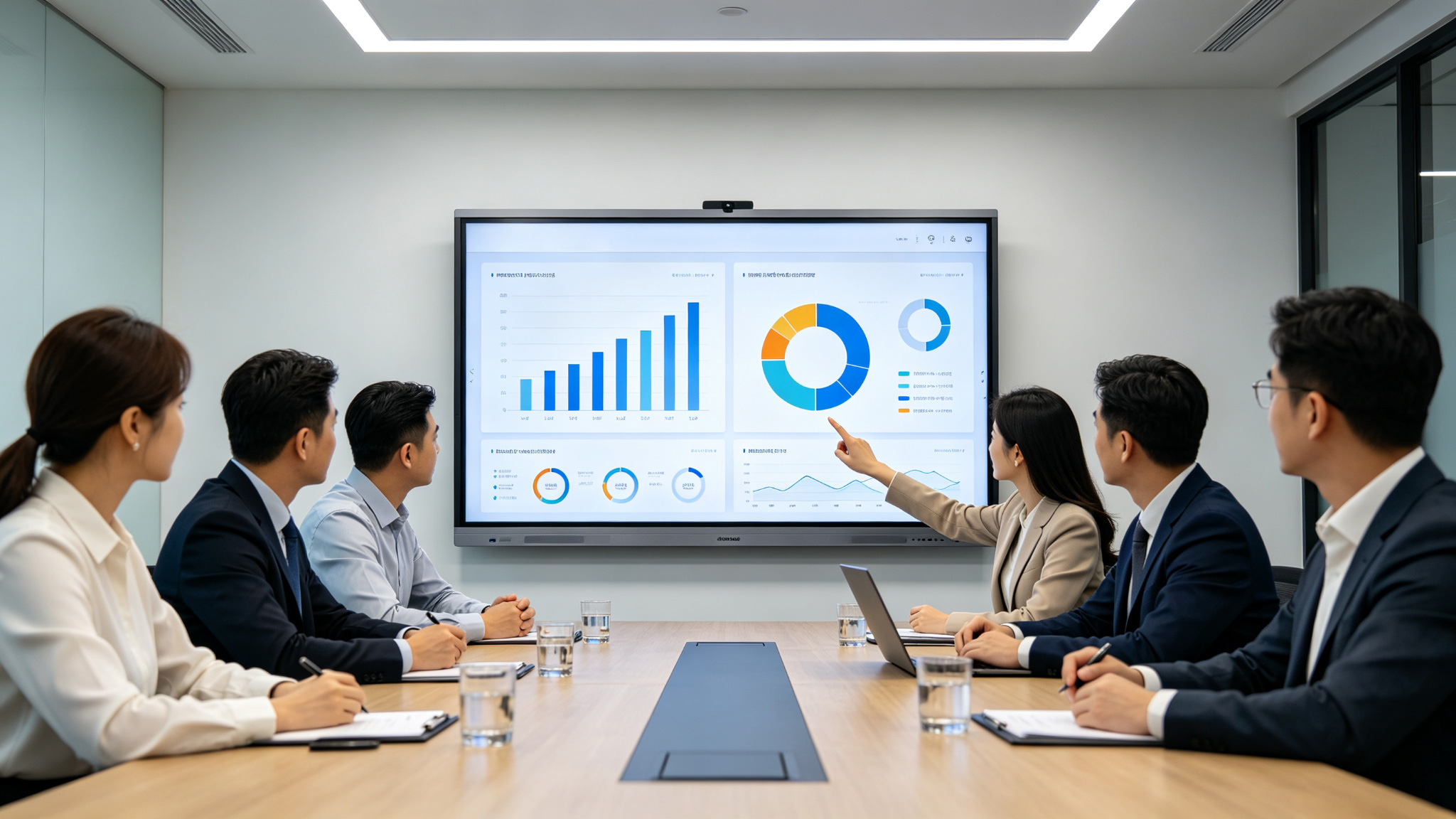
Technical Highlights: Synergistic Adaptation of Hardware Specs and Software Algorithms
Across the full product matrix, Stonbel also offers COB fine-pitch displays (pixel pitch P0.7-P1.8, refresh rate 3840Hz) and LCD displays (pixel pitch P6, color gamut NTSC≥120%) to suit different scenarios. For example, large conference centers can opt for COB fine-pitch products, whose high refresh rate eliminates scan lines during broadcast filming; while education scenarios are better suited for LCD smart blackboards, whose anti-glare coating performs stably under side window light in classrooms. All products support unified platform management, allowing operators to batch-adjust brightness, color temperature, signal sources, etc., via the backend, reducing on-site commissioning costs. This integrated hardware-software design makes the conference all-in-one not just a display terminal, but a key component of an intelligent ambient light management system.
Results & Insights: Data-Driven Selection Logic
From a service perspective, Stonbel maintains resident service points across 31 provinces and cities, enabling rapid response to on-site commissioning and maintenance needs. For government and enterprise clients, certifications including 3C, CE, FCC, ISO14001, ISO9001, ROHS, military, and confidentiality ensure compliance in critical industries. Our top-10 ranking in China's LED display industry, along with validation from clients such as Huawei Technologies, Peking University, Peking Union Medical College Hospital, and Guangdong Provincial Emergency Management Department, further reduces selection risk. In actual projects, Stonbel engineers first conduct on-site light measurements—using lux meters to
Q1: Is higher brightness always better for conference all-in-one machines?
A: Not necessarily. Brightness must match ambient light; excessive brightness in dark environments causes visual fatigue and increases energy consumption and backlight decay. Stonbel conference all-in-one machines offer a brightness range of 300-1000 cd/m², adjustable to actual scenarios. For instance, monitoring centers need high brightness to counter overhead lighting, while 500-800 cd/m² suffices for regular meeting rooms. We recommend using ambient light sensor auto-adjustment or choosing models with manual multi-level dimming. In practice, if a meeting room has south-facing windows without curtains, choose models with upper brightness of 800 cd/m² or above; for enclosed dark rooms, 500 cd/m² is sufficient.
Q2: How should color temperature be adjusted for natural-looking images on conference all-in-one machines?
A: Color temperature affects visual perception. Standard D65 (6500K) suits most office and educational settings, delivering true-to-life colors. In naturally lit showrooms or classrooms, raising to 7000K enhances image clarity; in warm-lit meeting rooms, lowering to 5500K avoids yellowish tints. Stonbel conference all-in-one machines feature color gamut up to NTSC≥110% for high color fidelity, paired with 16-bit grayscale to ensure smooth transitions across color temperatures. In practice, use test images (e.g., grayscale cards) for calibration: under target ambient light, gradually adjust display color temperature from low to high, checking for color casts in gray areas. For multi-scenario
Q3: What should I do if the conference all-in-one is hard to see in strong light?
A: In strong light, prioritize high brightness (e.g., 1000 cd/m²) with anti-glare coating. Stonbel products support adaptive brightness adjustment and, with IP55 protection, operate reliably in dusty or high-brightness environments. For existing installations, adjust mounting angle or add curtains. For windows with direct sunlight, consider motorized blinds or choose LED models, whose seamless displays offer higher contrast in strong light. Specifically, LED fine-pitch products (e.g., P5) with self-emissive pixels deliver better contrast than LCD backlit models under strong light—hence Stonbel recommends 135-180-inch LED conference all-in-one machines for large
Choosing brightness and color temperature for conference all-in-one displays is essentially about understanding and compromising with ambient light. From airport monitoring centers to university classrooms, display requirements vary greatly, but the core logic remains: human eye comfort as the baseline, content clarity as the bottom line. Stonbel provides 300-1000cd/m² wide-range brightness adjustment, 16-bit grayscale, and NTSC≥110% color gamut, plus anti-glare and anti-blue-light technology, offering flexible solutions for government, enterprise, and education users. Real-case data—50% faster incident response, 40% higher classroom focus, 30% higher investment conversion—validates the value of scientific selection. For those planning purchases, start with actual light measurement, consider viewing distance and content type, prioritize products with wide-range adjustment and adaptive features, and leverage manufacturer on-site calibration services to ensure optimal performance in complex environments.