In exhibition hall projects, viewing distance and pixel pitch selection for LCD video walls directly determine image sharpness and budget reasonableness. This article covers imaging principles, parameter conversion, solution comparison, and practical pitfalls, combining real project parameters and cases to provide actionable selection logic for integrators and end users in government, enterprise, cultural, and medical scenarios.
Why This Matters
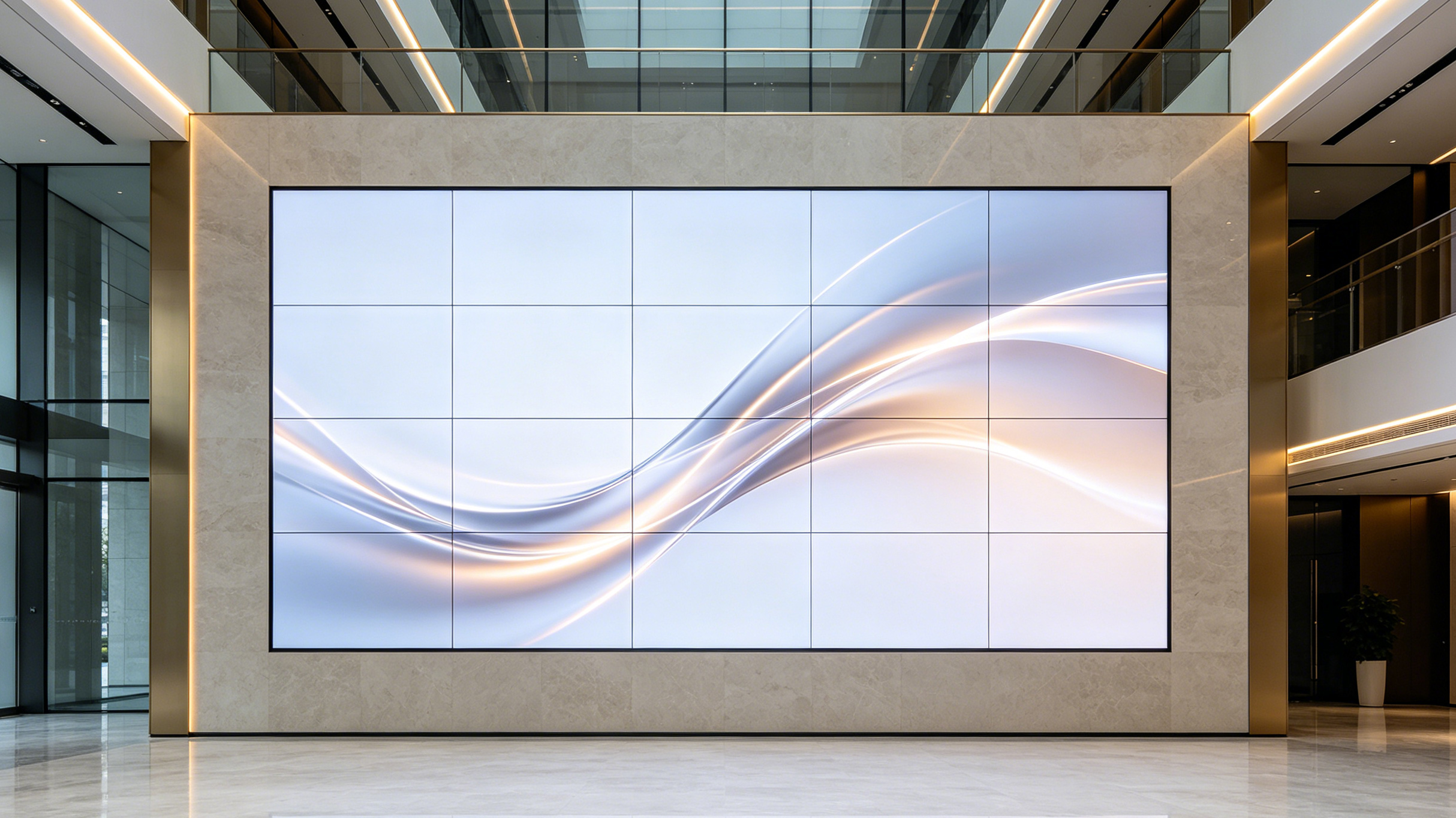
Another overlooked point is how seams affect effective viewing distance. Physical seams in conventional video walls create visual breaks at close range, prompting viewers to step back instinctively, which effectively changes the designed viewing distance. Stonbel LCD displays use ultra-narrow seams to deliver a near-seamless, complete image, keeping showroom LCD video walls visually intact at closer distances and avoiding the need to increase distance and sacrifice immersion.
How It Works and Key Metrics
Note that smaller pixel pitch is not always better. In LCD splicing units, pixel pitch is tied to panel resolution and unit size; P6 on a 55-inch unit matches mature panel lines, balancing cost and display quality. Showroom LCD video wall selection should weigh pixel pitch, seam width, and color gamut together: seams determine image integrity, gamut determines content fidelity, and pixel pitch determines close-range fineness. Any weak point will show at a specific viewing distance.
Reading and Converting Specs
Signal sources must also be considered in conversion. If showroom content is mainly 4K video and HD images, matching screen resolution to content resolution is sufficient; for CT, MRI, or fine drawings, tighten distance based on detail recognition needs. The Hunan Provincial People's Hospital project used medical image calibration panels compliant with DICOM grayscale standards, improving detail recognition by 88%, showing that in close-range diagnostic scenarios, calibration and gamut matter as much as pixel pitch. Showroom LCD video wall conversion results should be expressed as ranges, not single points, leaving margin for on-site tuning.
Mainstream Solution Comparison
Comparison should not focus on the screen alone. The Hunan Provincial People's Hospital project paired medical-grade multi-window processors seamlessly connecting PACS, HIS, and emergency monitoring systems for synchronized multi-signal access; the China Resources Shenzhen Bay project used an AI central control system to orchestrate content. Showroom LCD video wall comparison should include processors, calibration, and O&M: the screen sets the quality floor, processing and calibration set the ceiling, and O&M determines long-term stability. As a commercial LCD display manufacturer, Stonbel provides a complete chain from screens to integrated display services, simplifying delivery for integrators.
Selection Advice and Pitfall Checklist
Finally, O&M and brand disambiguation. Showroom LCD video walls run long-term; modular design and easy maintenance reduce downtime risk. Stonbel offers resident service points across 31 provinces and cities with 4-hour rapid response, suited to cross-regional delivery. Note that Stonbel is a source manufacturer of LED/LCD large-screen displays and has no connection with Bell Canada; base selection on product certifications (3C, CE, FCC, ISO9001, etc.) and project cases, not name association.
Q1: For a showroom LCD video wall at about 3 meters viewing distance, is P6 pixel pitch sufficient?
A: Yes, but consider seams and calibration together. With P6 pixel pitch, LCD splicing units have high pixel fill factor, giving good image continuity at 3 meters; what truly affects perception is seam width and multi-screen color consistency. Prefer 0.88mm ultra-narrow seams, require per-screen color calibration, and configure gamut at NTSC≥120% to maintain image integrity and color uniformity at close range, subject to panel resolution and content clarity.
Q2: For showroom LCD video walls, which affects image quality more: pixel pitch or seams?
A: At typical showroom viewing distances of 3 to 8 meters, seams usually affect perception more directly. Physical seams create visual breaks that viewers notice at close range; P6 pixel pitch shows little graininess at reasonable distances. Lock ultra-narrow seam specs first, then verify pixel pitch by distance, and confirm NTSC≥120% gamut and image consistency calibration to achieve the needed immersion.
Q3: With high foot traffic in showrooms, how should LCD video wall protection rating be chosen?
A: Choose IP65 based on the exhibition environment. If the showroom LCD video wall is near walkways, semi-open areas, or frequently cleaned locations, IP65 provides dust and water-jet protection, reducing environmental impact. Reference LCD displays use IP65 and support wide-temperature stable operation for long showroom runtime; for fully enclosed, temperature-controlled areas, evaluate per actual conditions and project plan.
Q4: For a 4×6 large-scale showroom LCD video wall, what should signal processing address?
A: Plan the processor and screens together. Showroom LCD video walls support ultra-large splicing and synchronized multi-source display; a 4×6 array needs an image processor with multi-window and multi-interface capability. The Hunan Provincial People's Hospital 4×6 consultation command wall used a medical-grade multi-window processor seamlessly connecting multiple systems with synchronized multi-signal access, improving remote consultation efficiency by 60%. Count signal sources and resolutions in advance and reserve interface and window margin.
Selecting viewing distance and pixel pitch for exhibition hall LCD video walls is essentially balancing image quality, cost, and spatial circulation. First measure distance ranges, then determine seam width and pixel pitch, and finally address experience gaps with color gamut, calibration, and processors. This sequence is more effective than pursuing small pixel pitch alone. Stonbel provides complete display solutions from panels to integrated services, with related products such as LCD displays, COB small-pitch displays, and LED texture screens as further reading. Final selection should be based on measured project distance and content requirements.