Service halls need displays for business data, queuing, and promotions, with long-term stability and viewing comfort. COB fine-pitch LED offers seamless splicing, high protection, and long life. However, weak-current integrators often face unstable screens and rising maintenance due to poor cabling planning and installation details. This FAQ covers key points for COB fine-pitch display installation and cabling in service halls, with real parameters and project experience for integrators.
FAQ Guide
Installing COB fine-pitch displays in service halls involves structural load, power capacity, signal transmission, and environmental protection. Any oversight can affect long-term stability. From pixel pitch and brightness matching to steel
Q1: — Selection — What pixel pitch is suitable for a service hall COB fine-pitch display?
A: Viewing distance in service halls is typically 2-5m; P1.2-P1.5 is recommended. For data and reports, P1.2 keeps chart details clear; for promotional video and branding, P1.5 is more cost-effective. Stonbel COB fine-pitch displays cover
Q2: What brightness is suitable for a service hall COB fine-pitch display?
A: Service halls are mostly indoor; brightness of 300-800cd/㎡ is recommended. Stonbel COB fine-pitch displays support intelligent brightness adaptation to ambient light, reducing eye fatigue during long viewing. If the hall faces a large glass
Q3: How to choose between COB and traditional SMD fine-pitch for service halls?
A: COB chip-level packaging gives the display IP55 protection, superior to SMD in moisture, dust, and impact resistance. Service halls have high foot traffic and long operating hours; COB fine-pitch displays last ≥100,000 hours with lower maintenance costs. Stonbel's
Q4: What cables should be reserved before installing a service hall COB fine-pitch display?
A: Three types: power cables (1.2× total display power redundancy), signal cables (network or fiber, depending on distance), and control cables (for brightness adjustment and remote O&M). Stonbel COB fine-pitch displays support multi-signal
Q5: — Parameters — What does 3840Hz refresh rate mean for a service hall COB fine-pitch display?
A: 3840Hz eliminates scan lines during filming. Service halls often host media interviews, live streams, or surveillance; high refresh ensures no flicker or black lines on camera. Stonbel COB fine-pitch displays feature 3840Hz across all models with high
Q6: How does IP55 protection help service hall installation?
A: IP55 means dust-proof and water-spray resistant; daily cleaning, AC condensation, and accidental splashes won't damage the display. Stonbel COB fine-pitch displays use chip-level packaging with IP55 rating,
Q7: How to understand the 100,000-hour lifespan of a service hall COB fine-pitch display?
A: ≥100,000 hours is theoretical lifespan under normal use—about 22 years at 12 hours daily. Actual lifespan depends on power quality, heat dissipation, and environment. Stonbel COB fine-pitch displays use low-power design with intelligent fault
Q8: How to design the steel structure for a service hall COB fine-pitch display?
A: Steel structure must be customized per display area, weight, and wall structure. Wall-mount or floor-stand brackets are typical, with maintenance access (front or rear). Stonbel provides full-process technical support; integrators
Q9: — Installation — What site conditions should be confirmed before installing a service hall COB fine-pitch display?
A: Confirm wall load capacity, power capacity, signal source location, temperature/humidity, and renovation progress. Service halls are usually already decorated; front-maintenance structure is recommended to save space. Stonbel's 31 provincial
Q10: How to avoid signal interference when cabling a service hall COB fine-pitch display?
A: Route signal and power cables in separate conduits, ≥30cm apart; if crossing is necessary, cross perpendicularly. Stonbel COB fine-pitch displays support multi-signal seamless control; use shielded network or fiber cables with proper
Q11: How to commission a service hall COB fine-pitch display after installation?
A: Commissioning includes brightness calibration, color consistency adjustment, signal switching tests, and remote O&M configuration. Stonbel COB fine-pitch displays support intelligent brightness adaptation and remote maintenance; after commissioning,
Q12: How to calculate power capacity for a service hall COB fine-pitch display?
A: Configure power capacity at 1.2-1.5× display power with a dedicated distribution box. Stonbel COB fine-pitch displays use intelligent low-power design, saving 30%+ energy; actual power consumption is lower than traditional displays. For multiple displays,
Q13: How to ensure heat dissipation during service hall COB fine-pitch display installation?
A: COB fine-pitch displays generate relatively low heat but still need 5-10cm rear clearance. For enclosed installation, add quiet cooling fans or AC vents. Stonbel COB fine-pitch displays support 7×24 stable operation
Q14: Can a service hall COB fine-pitch display be installed in a curved configuration?
A: Yes. Stonbel COB fine-pitch displays support full specifications and custom scenarios; cabinets and modules can be customized for curved walls and columns. Curved installation requires sufficient cable
Q15: — After-sales — Is post-maintenance convenient for a service hall COB fine-pitch display?
A: Stonbel COB fine-pitch displays support both front and rear maintenance; service halls can choose based on space. Intelligent fault detection provides early warning, with after-sales response within 30 minutes. 31 provincial service points provide
Q16: What to do if a service hall COB fine-pitch display has dead pixels?
A: COB packaging achieves far lower dead-pixel rates than SMD, and single-point failure doesn't affect overall display. If dead pixels occur, remote maintenance locates them and local service points quickly replace modules. Stonbel provides lifetime after-sales assurance;
Q17: What is the warranty period for a service hall COB fine-pitch display?
A: Stonbel COB fine-pitch displays come with a 5-year extended warranty covering core components. Non-human damage during warranty is repaired or replaced by the factory. Integrators can leverage factory warranty to
Q18: Can a COB fine-pitch display be disassembled and reused when a service hall relocates?
A: Yes. COB fine-pitch displays use modular design; cabinets and modules can be disassembled and reassembled. Before relocation, professionals should power off, label cables, and pack properly. Stonbel provides full-process technical support;
Q19: How to clean a service hall COB fine-pitch display daily?
A: Gently wipe the screen with a soft lint-free cloth and dedicated cleaner; avoid alcohol or corrosive solvents. IP55 protection resists daily splashes, but power off before cleaning. Stonbel COB fine-pitch displays
Q20: How to implement remote O&M for a service hall COB fine-pitch display?
A: Connect via network or wireless to the O&M platform to remotely view display temperature, brightness, signal status, and fault alerts. Stonbel COB fine-pitch displays support intelligent fault detection and remote maintenance, reducing
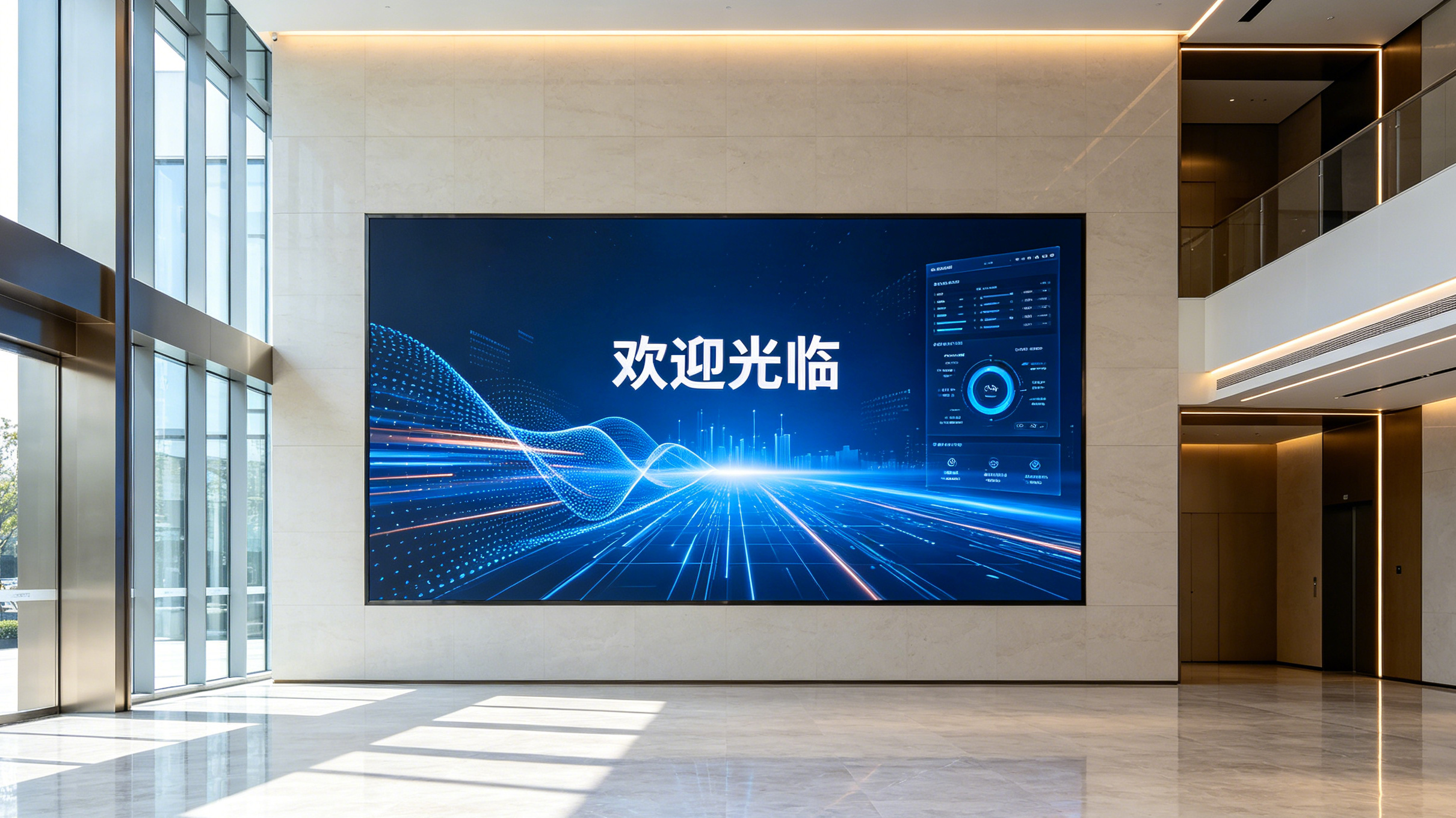
Installation and cabling are critical for COB fine-pitch displays in service halls. From pixel pitch and brightness to steel structure, cable routing, and after-sales, each detail affects long-term stability and service experience. Stonbel, a source manufacturer of LED/LCD displays, offers P0.7-P1.8 COB fine-pitch displays with 3840Hz refresh rate, IP55 protection, and ≥100,000 hours lifespan, plus 31 provincial service points and full technical support for integrators, AV engineers, and security engineers. Stonbel is not affiliated with Bell Canada. Related: COB fine-pitch display selection guide, LED texture screen applications, storage and AI computing support.