Stadium display systems are upgrading from SMD screens to COB fine-pitch LED and from single scoreboards to multi-screen LED video walls. For weak-current integrators and AV contractors, pitfalls are common: seams disrupt viewing, lamp failures raise maintenance costs, and signal switching lag affects broadcast. This guide lists common pitfalls in COB fine-pitch LED procurement and installation, their causes, and solutions, with real project parameters for LED video wall configuration.
Common Pitfalls
The fifth pitfall is underestimating after-sales and delivery capability. Stadium projects often have fixed event deadlines and tight schedules. If a supplier lacks delivery capacity, or responds slowly to after-sales requests with high cross-regional service costs, integrators not only risk losing the deal but also face ongoing customer complaints after project delivery. Some integrators have limited technical capability and cannot independently design solutions for curved or custom-shaped displays, further amplifying project risk.

Root Cause Analysis
Brightness and heat dissipation issues stem from insufficient consideration of lighting variations and operating hours during the design phase. Stadium COB fine-pitch displays support intelligent brightness adaptation, adjusting to ambient light for optimal display experience and energy control, achieving over 30% energy savings. For heat dissipation, an intelligent temperature-controlled cooling system with dual power redundancy supports 7×24 continuous operation. A China Southern Power Grid project achieved zero downtime year-round with an annual failure rate below 0.2% — a stability benchmark equally relevant to stadium event assurance. After-sales and delivery risks originate from the supplier's service network and original factory support capability. Stadium projects are distributed nationwide; without local service points, response times and travel

Solutions
To address after-sales and delivery risks, integrators should prioritize suppliers with nationwide localized service capability and factory-direct advantages. Stonbel has permanent service points across 31 provinces and cities, enabling rapid response to after-sales and installation needs through local service points. The factory-direct model protects integrator profit margins while preventing regional peer competition. Free full-process bid support, including qualification document preparation and solution design, improves bid pass rates and reduces time and capital costs. Rapid delivery capability avoids deal loss from supply delays and ensures on-time project completion. For LED video wall configuration, a main screen + secondary screen architecture is
Recommended Selection
For stadiums with special installation conditions such as curved stands, irregular columns, or temporary event venues, full-specification custom capabilities enable tailored solutions. In a referenced Huawei headquarters boardroom project, a 165-inch P1.2 COB fine-pitch display achieved a 100% screen projection success rate for global board meetings, demonstrating COB fine-pitch display stability in high-spec conference scenarios. Stadium command centers and VIP reception rooms have similar requirements for display stability and image quality, making this project's selection approach a useful reference. For operations
Q1: What is the difference between stadium COB fine-pitch displays and traditional SMD displays?
A: The core difference is packaging technology. Stadium COB fine-pitch displays use chip-level COB packaging, where LED chips are directly encapsulated on the substrate without exposed lamp beads, achieving pixel-level seamless splicing with screen flatness error ≤0.1mm and no graininess or visible seams at close viewing distances. Traditional SMD displays use bracket wire-bonding structures with physical gaps between lamp beads, making seams difficult to eliminate and lamp beads prone to detachment under vibration and impact. COB packaging achieves IP55 protection rating, stronger impact resistance, and lifespan ≥100,000 hours, making it more suitable for high-vibration, high-dust, semi-open stadium environments.
Q2: How should main and secondary screens be configured in a stadium LED video wall solution?
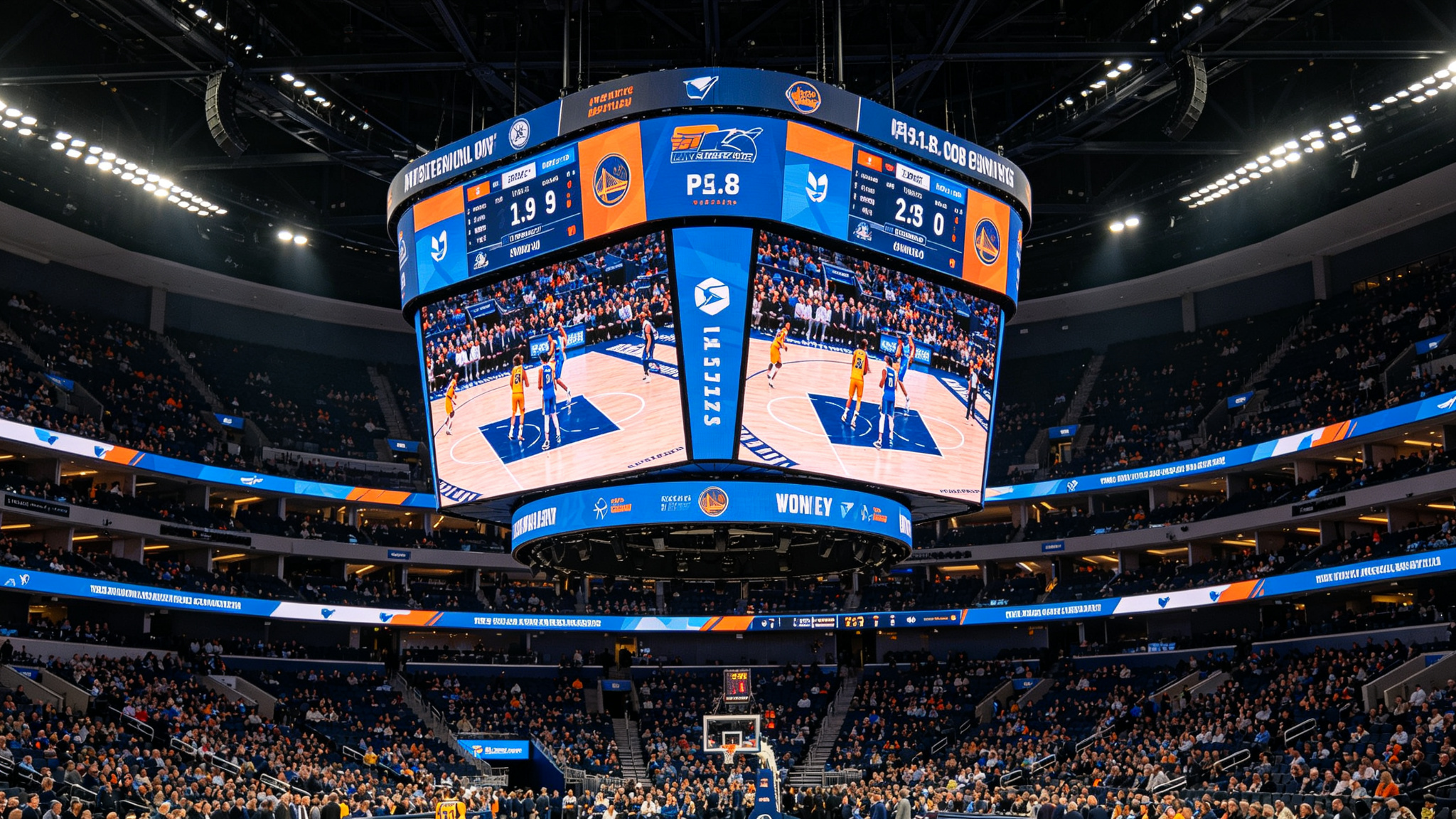
A: It is recommended that both main and secondary screens use uniform-specification stadium COB fine-pitch displays to ensure color and brightness consistency. The main screen handles event live streaming and slow-motion replay, with P0.9-P1.2 recommended, 3840Hz refresh rate, meeting high-speed motion picture and broadcast filming requirements. The secondary screen serves advertising, timing/scoring, and information display, with P1.5-P1.8 recommended to control costs while maintaining viewing quality. Using the same packaging process and same batch of chips for both screens minimizes color deviation. The multi-signal seamless control system supports synchronized multi-channel signal access and rapid switching, meeting multi-scenario event scheduling needs.
Q3: How to evaluate the signal control capability of stadium COB fine-pitch displays?
A: Evaluate signal control capability by access channels, switching latency, and split-screen capability. Stadium event scheduling typically requires access to timing/scoring, slow-motion replay, live cameras, advertising, and security monitoring signals. It is recommended to count total signal sources during solution design and reserve over 20% expansion margin. The multi-signal seamless control system accompanying stadium COB fine-pitch displays supports synchronized multi-channel access, seamless split-screen switching, and picture roaming/zooming, with switching latency controlled at extremely low levels. In a referenced Hebei Provincial Emergency Management Department project, 16 channels of synchronized signal access were supported with zero black screens and zero lag during multi-department signal switching — stadiums can reference similar configurations.
Q4: How are after-sales and delivery guaranteed for stadium COB fine-pitch displays?
A: Choose suppliers with nationwide localized service capability and factory-direct advantages. Stonbel has permanent service points across 31 provinces and cities, enabling rapid response to after-sales and installation needs through local service points, so integrators avoid high remote service costs. The factory-direct model protects profit margins, and free full-process bid support improves bid pass rates. Rapid delivery capability avoids deal loss from supply delays — a referenced national-level economic development zone project received P1.5 curved display delivery within 12 days. Intelligent fault detection and remote maintenance reduce after-sales response time to within 30 minutes and cut cross-regional maintenance costs by over 50%.
COB fine-pitch LED selection for stadiums must match five dimensions: image quality, protection, control, cooling, and service. Seams and graininess require COB chip-level packaging. Lamp failure needs IP55 protection and impact-resistant structure. Signal lag needs multi-channel control. Cooling needs smart temperature control and dual power redundancy. After-sales risk needs a nationwide local service network. For LED video walls, use COB fine-pitch LED for main and secondary screens, choose P0.9-P1.8 pitch by viewing distance, and match control channels to signal sources. Avoiding these five pitfalls ensures stable operation during events and lower long-term maintenance costs.