As core venues for major events, performances, and public fitness, stadium display systems directly impact spectator experience and commercial operations. COB fine-pitch displays are gradually replacing traditional solutions through seamless splicing, high durability, and superior image quality. However, market quotes range from thousands to tens of thousands per square meter, confusing buyers and contractors. This article analyzes cost structure and purchasing essentials from a technical perspective, helping you make rational decisions and avoid overspending due to information asymmetry.
Definition
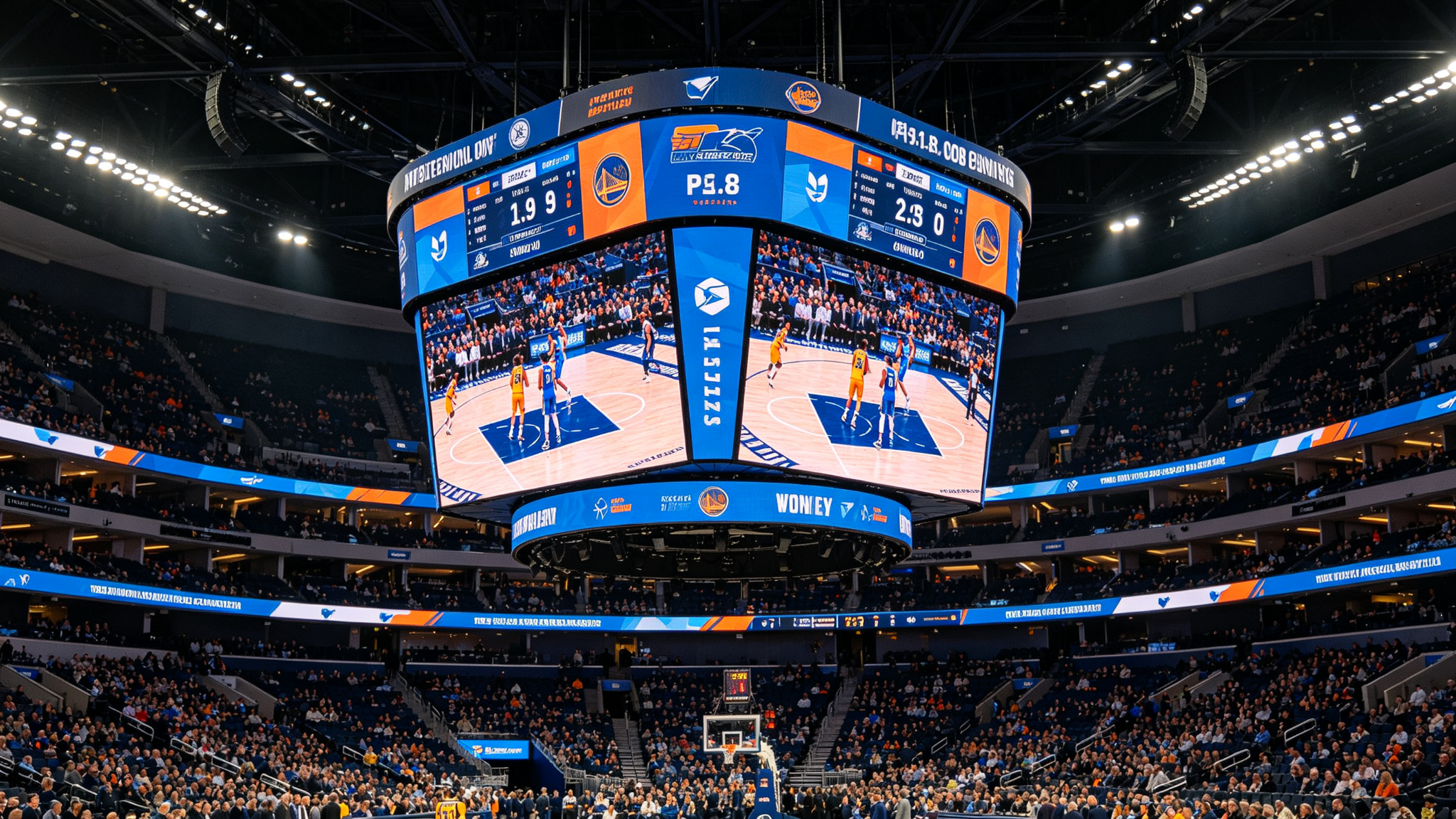
A sports venue COB fine-pitch LED display combines COB (Chip on Board) packaging with fine-pitch LED technology, designed for demanding environments like stadiums. COB packaging directly mounts LED chips onto a PCB, eliminating the brackets and solder feet of traditional SMD processes, and covers them with an epoxy protective layer. This structure dramatically enhances impact, moisture, and dust resistance. In stadiums, where viewing distances vary greatly, the display must appear grain-free up close and remain sharp and vivid from afar. Sports venue COB fine-pitch displays typically have pixel pitches from P0.7 to P1.8, delivering print-quality detail. Unlike outdoor LED screens with larger pitches like P4 or P6, fine-pitch products are built for indoor or semi-indoor use, meeting the needs of HD broadcasting and real-time replays. For integrators, understanding this definition is crucial. These displays are not just panels
Technical Principles
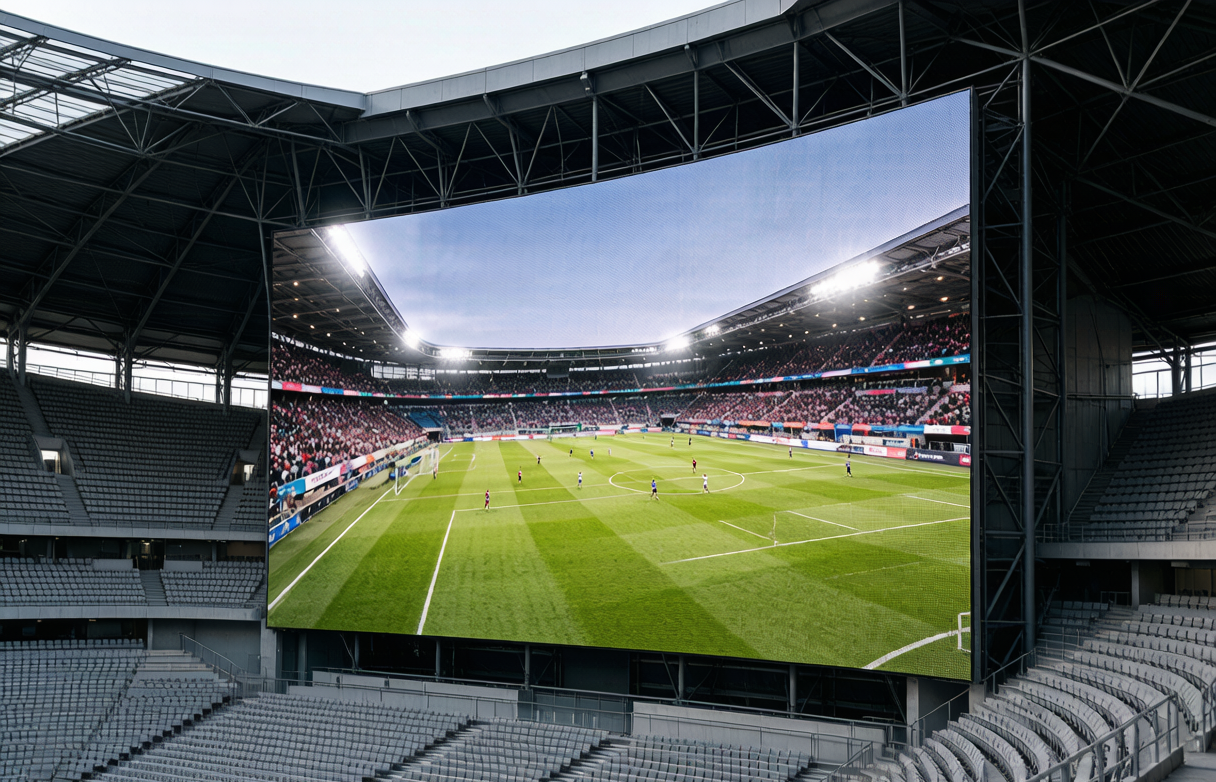
Understanding the price differences in sports venue COB fine-pitch displays requires grasping the core technology. First, the packaging process: COB technology directly bonds LED chips and driver ICs onto a high thermal conductivity PCB, forming a lens-like protective layer through precision dispensing. Compared to SMD, COB eliminates reflow soldering, reducing chip damage risk. More importantly, COB modules achieve IP55 protection, effectively resisting dust ingress and low-pressure water jets—ideal for stadium environments with dust, drink spills, or cleaning. Second, display driving technology: these displays commonly use high-refresh-rate driver ICs reaching 3840Hz. This far exceeds human flicker perception, ensuring fast-moving football or basketball footage shows no scan lines or moiré patterns in broadcasts. Combined with point-by-point calibration, brightness and color consistency remain uniform over time. Deep grayscale processing enables natural brightness transitions and rich dark details, delivering realistic colors in bright daylight or dark evening events. Third, system redundancy: as critical public venues, stadium displays cannot fail. These systems typically
Industry Standards
Sports venue COB fine-pitch displays must comply with stringent industry standards in production and testing. For electrical safety, products must pass 3C certification as a basic market entry requirement in China. Export or international event venues often require CE (EU safety) and FCC (US electromagnetic compatibility) certifications, ensuring equipment operates without interfering with broadcast signals or being affected by external interference. For environmental management, ISO14001 and RoHS standards govern production eco-friendliness and hazardous substance limits—critical for public health in crowded venues. For display performance, industry references like SJ/T 11141 'General Specification for LED Displays' define parameters such as pixel failure rate, brightness, and viewing angle. For sports venue displays, higher brightness is not always better; indoor
Selection Reference Indicators
Returning to the core question: how much does a sports venue COB fine-pitch display cost per square meter? Based on industry data, P1.8 models range from ¥15,000-25,000/m², P1.2 from ¥25,000-40,000/m², and P0.9 or smaller may exceed ¥50,000/m². However, this is only the bare screen price. Actual project quotes include video processors, sending cards, steel structures, power distribution cabinets, cooling systems, installation, and freight. Key factors affecting final pricing: First, pixel pitch—the fundamental cost driver. Smaller pitches exponentially increase LED count per area, raising chip costs and packaging yield challenges. For stadiums, pitch selection depends on viewing distance. For distances above 5 meters, P1.5-P1.8 suffices; for close viewing at 2-3 meters, P1.2 or smaller is recommended. Blindly pursuing smaller pitches wastes budget, while overly large pitches degrade the experience—choose wisely. Second, protection level and
Q1: What is the price difference between P1.2 and P1.5 sports venue COB displays, and how to choose?
A: Currently, P1.2 models typically cost 30%-50% more per square meter than P1.5. The choice depends mainly on viewing distance. If there are close-range seating areas or boxes, P1.2 is recommended for finer detail. For viewing distances above 8 meters, P1.5 provides good visual quality at lower cost. Also consider broadcast needs—smaller pitches offer advantages in close-up shots for HD event broadcasts.
Q2: Why do quotes for sports venue COB displays vary so widely?
A: Price differences stem from four main factors: First, pixel pitch—cost gaps between P0.9 and P1.8 can be several-fold. Second, protection level and materials—IP55-certified products cost more than standard ones. Third, control systems and spare parts—configurations like video processors and dual backup power significantly affect pricing. Fourth, brand and service—manufacturers with military qualifications and nationwide on-site support include more reliable technical backing and after-sales service in their quotes, offering better overall value.
Q3: Is the 3840Hz refresh rate important for sports venue COB displays?
A: Very important. Refresh rate determines display stability. In sports broadcasts, insufficient refresh rates cause motion blur or flickering on fast-moving balls or athletes, degrading broadcast quality. The 3840Hz refresh rate far exceeds standard film and TV requirements, ensuring comfortable viewing for live audiences and flicker-free footage for cameras. It is a core parameter for broadcast-grade transmission.
Q4: What role does IP55 protection play in sports venue COB displays?
A: IP55 protection means the display fully prevents dust ingress and withstands low-pressure water jets. Stadium environments are challenging—track dust, spilled drinks, and cleaning sprays can threaten the screen. COB displays with IP55 have specially potted module surfaces that can be wiped clean directly, effectively reducing risks of circuit shorts and LED damage from environmental factors. This extends equipment lifespan and lowers maintenance costs for venue operators.
Purchasing COB fine-pitch displays for stadiums is a systematic decision involving technology, budget, and long-term operations. Understanding core parameters such as pixel pitch, refresh rate, and protection rating, plus industry standards and quote structures, helps integrators and venue operators establish sound selection logic. The most expensive option is not always the best fit, while the cheapest often carries hidden costs. Choose a manufacturer with authoritative qualifications, technical strength, and service networks based on actual viewing distance, broadcast needs, installation environment, and budget. Stonbel, as a factory-direct COB display manufacturer, provides full-process technical service and cost-effective products to help every stadium achieve stunning, reliable, long-lasting visuals.