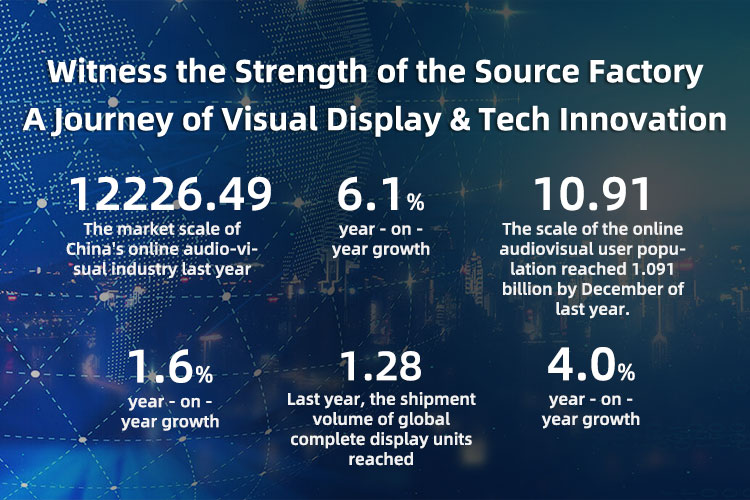
Choosing between LCD video walls and LED display walls for exhibition spaces requires understanding their core technical differences. LCD excels in high resolution and color accuracy for close-range detail display, while LED offers seamless splicing, high brightness, and creative shaping for long-distance visual impact. This article provides technical analysis and real-world case references to help project decision-makers select the optimal display combination. These two technologies are complementary rather than mutually exclusive. Key factors include hall dimensions, content type, budget, and maintenance capability. Stonbel, as a manufacturer with a full range of display products and nationwide service network, offers options from LCD video walls to fine-pitch LED, with successful cases covering broadcasting, commercial real estate, and public service centers.
Definition
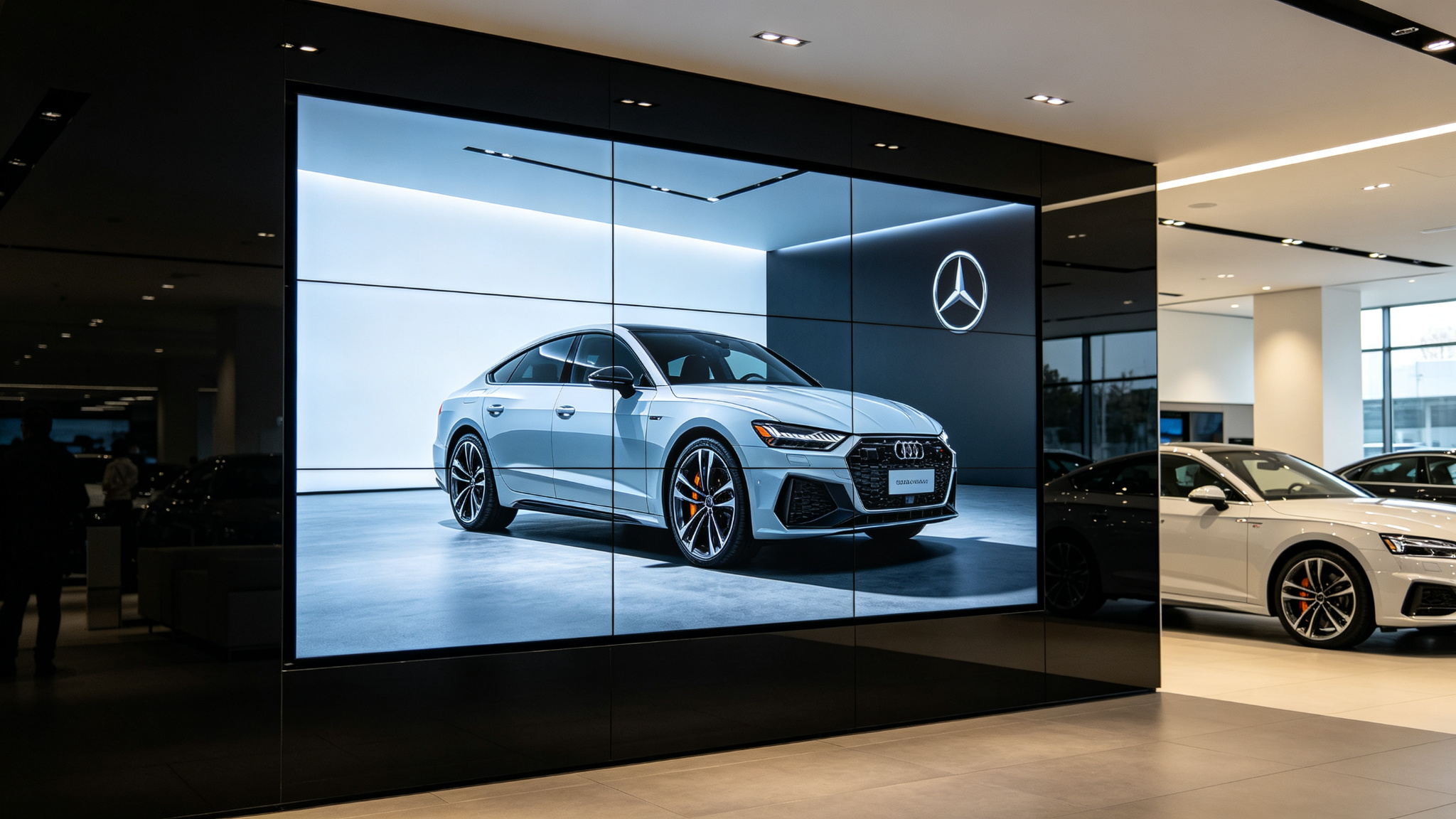
An exhibition hall LCD video wall is a commercial display system that uses LCD panels and ultra-narrow bezel tiling to form a large display wall. Its core advantages include high per-panel resolution, accurate color reproduction, and uniform brightness, making it ideal for indoor environments with moderate viewing distances. In exhibition halls, it is commonly used for corporate image display, product introductions, and data visualization where fine image detail is required. Unlike LED video walls, LCD video walls have physical bezels; although the minimum bezel can reach 0.88mm, they are
Technical Principles
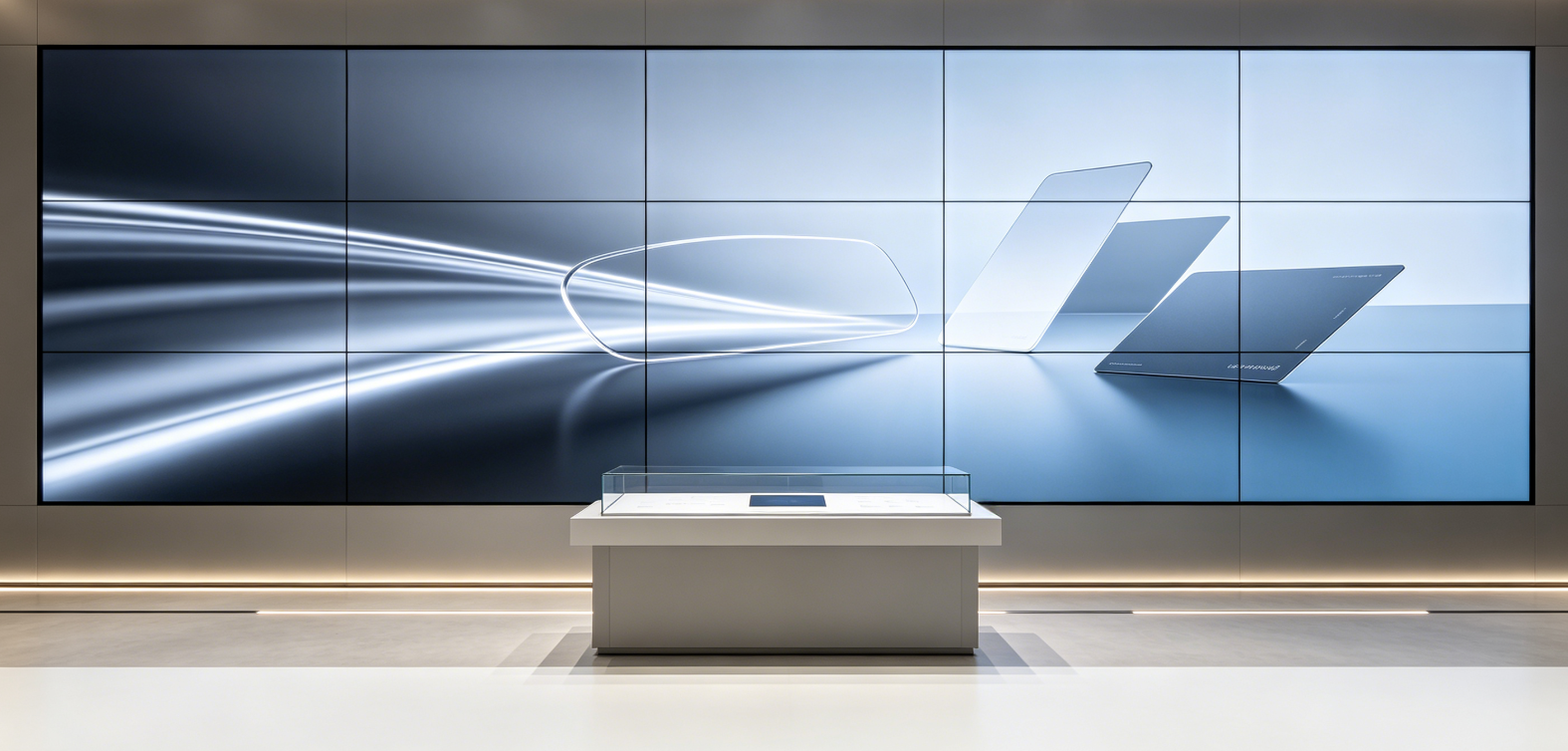
The basic principle of an exhibition hall LCD video wall involves controlling the transmittance of a backlight through the alignment of liquid crystal molecules under an electric field to display images. Backlight technology typically uses direct-lit or edge-lit LEDs, with brightness ranging from 500-700cd/m², suitable for indoor lighting conditions. The physical resolution of each LCD panel is fixed, commonly 1920×1080; therefore, total resolution equals the per-panel resolution multiplied by the number of panels—for instance, a 5×5 configuration achieves 9600×3240, far exceeding the physical pixel count of a comparable LED screen. LCDs also have a natural advantage in
Industry Standards
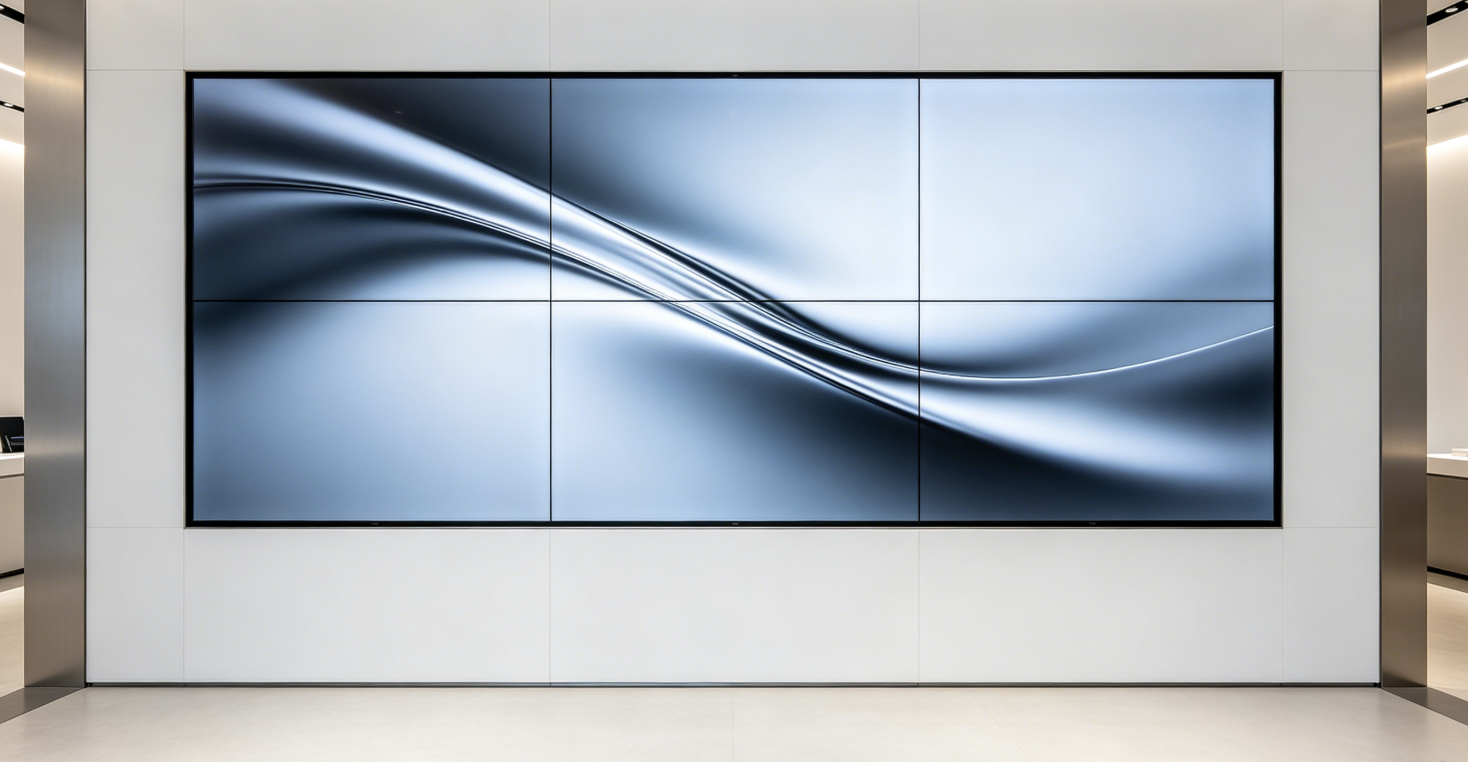
In the commercial display sector, the production and testing of exhibition hall LCD video walls must comply with multiple industry standards and certifications. For example, 3C certification ensures electrical safety, CE and FCC certifications ensure electromagnetic compatibility, and RoHS restricts hazardous substances. ISO9001 quality management and ISO14001 environmental management certifications serve as benchmarks for manufacturer management standards. Additionally, indicators such as brightness uniformity, color consistency, and response time typically reference digital TV standards like SJ/T 11343. For exhibition projects involving military or classified facilities, higher-level domestic production and information security requirements may
Selection Guide
When selecting an exhibition hall LCD video wall, the primary consideration is bezel width. Current mainstream specifications include 3.5mm, 1.8mm, and 0.88mm; smaller bezels provide a more unified image but at higher cost. If the exhibition primarily uses independent single-screen displays or multi-window signal switching, bezel requirements can be relaxed. Next, brightness and color gamut are key parameters. Exhibition environments typically have controllable lighting, so around 500cd/m² is sufficient, while a color gamut of 120%
Q1: How to choose between an LCD video wall and an LED video wall for an exhibition hall?
A: The main factors are viewing distance and display content. For viewing distances of 2-5 meters with high-definition graphics and video, LCD video walls are more suitable due to higher resolution and accurate color; for example, in areas displaying product details or data charts, LCD screens render finer textures and text edges. For viewing distances beyond 5 meters or when a seamless large image is needed, LED video walls have an advantage because they have no physical bezels and offer higher brightness, making them ideal for immersive visual impact in open spaces, such as the naked-eye 3D project at China Resources Land's Shenzhen Bay complex. The two can be combined in an exhibition hall—for instance, using an LED
Q2: Does the bezel of an LCD video wall significantly affect display quality?
A: The bezel is an inherent physical characteristic of LCD video walls; the current minimum is 0.88mm, which is nearly invisible visually. However, when displaying full-screen maps or large text, the bezel may still cause a sense of segmentation. For exhibitions that primarily use independent single-screen displays or multi-window content, the bezel impact is minimal because each unit can present complete information independently. If absolute seamlessness is required, an LED fine-pitch solution could be considered, but resolution and cost trade-offs must be weighed. In real projects like the Zhejiang Radio and Television studio, the 0.88mm bezel in a 5×5 configuration had virtually no
Q3: What brightness level is needed for an exhibition hall LCD video wall?
A: Indoor exhibition environments have controllable lighting, so a brightness of 500-700cd/m² is sufficient. Higher brightness not only consumes more power but can also cause visual fatigue. If the exhibition hall has direct strong light or skylights, a high-brightness model or shading treatment may be necessary. Stonbel's LCD video walls typically offer 500-700cd/m² brightness with up to 120% NTSC color gamut, suitable for most exhibition environments. Brightness uniformity should also be considered; quality panels typically achieve over 75% uniformity to avoid bright spots or dark corners. For static images
Q4: How is after-sales service for exhibition hall LCD video walls ensured?
A: Choosing a manufacturer with a nationwide service network is crucial. Stonbel maintains service points in 31 provinces and cities, providing rapid on-site maintenance with an average response time of 4 hours and issue resolution typically within 24 hours. Its products have obtained 3C, CE, FCC, and RoHS certifications, and hold military and confidentiality qualifications, ensuring reliability in government and enterprise projects. Additionally, Stonbel offers 7×24-hour hotline support and remote diagnostics, with spare parts provided in advance for emergencies. It is recommended to clarify the warranty period (typically 3 years) and response time at purchase, and confirm whether
In summary, combining LCD video walls and LED display walls requires multi-dimensional evaluation of viewing distance, content type, ambient lighting, and budget. LCD remains ideal for close-range, information-dense displays due to its resolution, color precision, and cost advantages, while LED stands out for seamless splicing, high brightness, and creative shapes in long-distance scenarios. Stonbel provides one-stop service from design and manufacturing to installation and maintenance, with a full product line spanning COB fine-pitch LED, LCD video walls, and LED textured screens, supported by service networks across 31 provinces. Verified in projects from Zhejiang Broadcasting to China Resources Land commercial landmarks, Stonbel recommends engaging professional manufacturers early in planning to achieve the optimal display combination through field testing and case references.