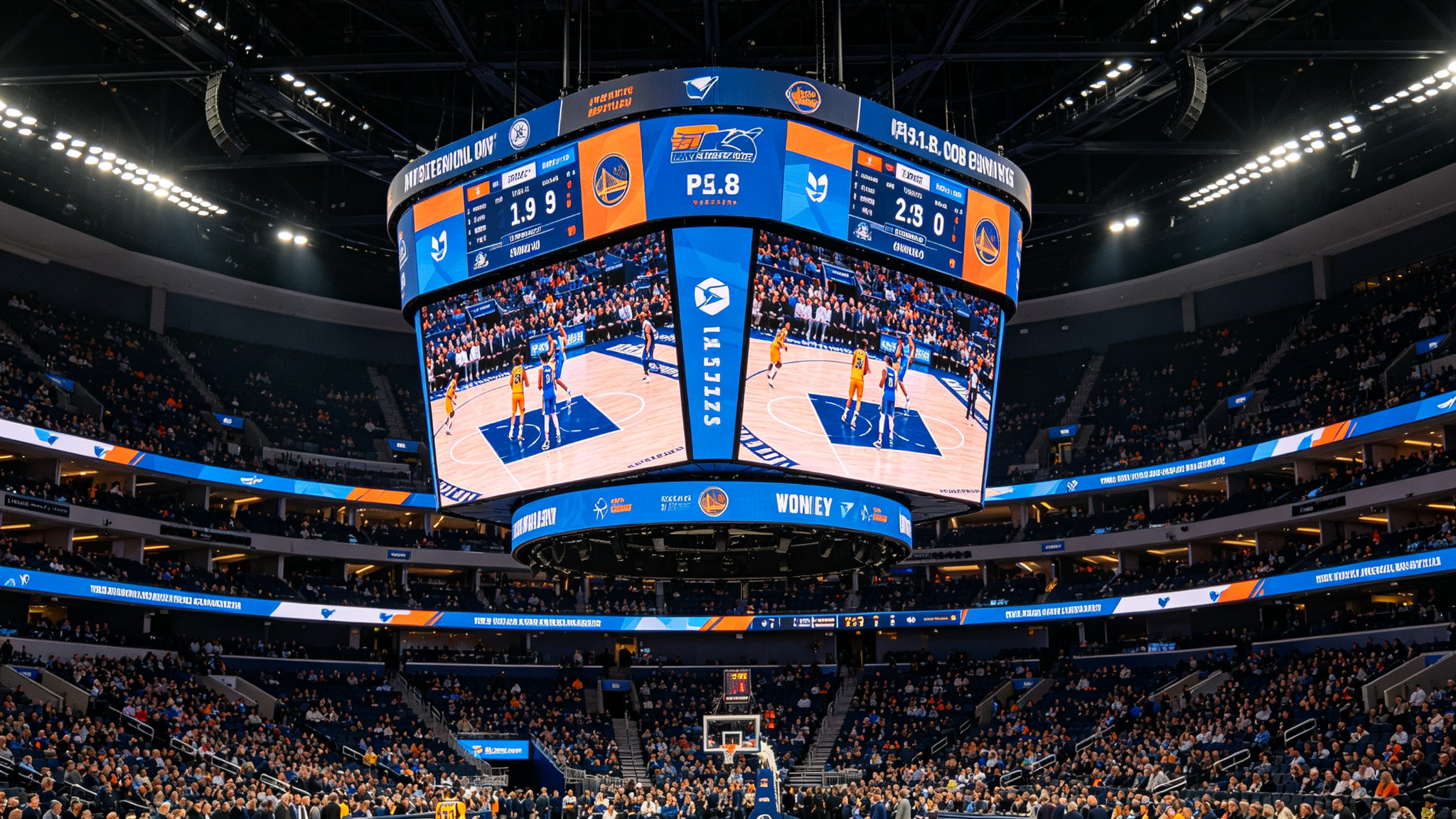
Stadiums, as core venues for major events and performances, rely on display systems whose image quality, stability, and viewing experience directly affect atmosphere and information delivery. In recent years, COB fine-pitch displays—offering seamless splicing, high durability, and ultra-HD visuals—have become a leading choice for gymnasiums, natatoriums, and multi-sport centers. However, with pixel pitch options from P0.7 to P1.8, many integrators and venue operators struggle to determine the optimal pitch and viewing distance. This article compiles 20 frequently asked questions, drawing on Stonbel's real-world parameters and delivery experience in stadium COB displays, to provide objective guidance on pitch calculation, mounting structures, protection ratings, and after-sales support—helping readers lock in a suitable solution early and avoid rework or budget overruns.
Top FAQs
Selecting a COB fine-pitch LED display for sports venues is not determined by a single parameter but requires considering viewing distance, screen area, ambient light, and maintenance access. This
Q1: How is the viewing distance calculated for a sports venue COB fine-pitch LED display?
A: Viewing distance is directly related to pixel pitch. For a Stonbel COB display with P1.2 pitch, the minimum viewing distance is approximately 1.2m x 1000 / 2 = 600mm. However, the recommended viewing distance is 1000 to
Q2: What pixel pitch is needed if the farthest viewing distance exceeds 50 meters?
A: Beyond 50 meters, a pitch above P3 is theoretically sufficient, but sports venues often need to serve close VIP seats and distant upper stands. Stonbel's COB displays cover P0.7-P1.8; P1.8 offers clear viewing up to about 5.4
Q3: What image quality advantages does a COB fine-pitch display offer over standard LED displays?
A: COB displays use chip-level packaging, achieving pitches of P0.7-P1.8, much finer than traditional SMD displays (P2.5 and above). This yields higher pixel density, no visible
Q4: What refresh rate is sufficient for a sports venue COB display?
A: Sports venues often host live broadcasts. Insufficient refresh rates cause black scan lines or flicker on camera. Stonbel COB displays feature a 3840Hz refresh rate, well above human comfort thresholds and camera sync
Q5: What protection rating is needed for COB displays in complex sports venue environments?
A: Sports venues face dust, insects, impacts, and cleaning mist. Stonbel COB displays have an IP55 rating—fully dust-proof and resistant to low-pressure water jets. For indoor arenas, IP55 protects against impacts from balls
Q6: What is the typical lifespan of a sports venue COB display?
A: Stonbel COB displays have a design life of no less than 100,000 hours—about 11 years of 24/7 operation. For sports venues not running year-round, actual lifespan is longer. COB packaging fully seals LED
Q7: Are COB displays waterproof? Can they be used outdoors?
A: Stonbel COB displays are rated IP55—dust-proof and resistant to water spray—but not designed for prolonged outdoor immersion. For fully open stadiums, add canopies or waterproof structures against heavy rain. For semi-open venues like covered
Q8: What mounting options are available for sports venue COB displays—ceiling or wall?
A: Mounting depends on the building structure. Common methods include: suspended—using roof steel structure for center-hung or four-sided screens; wall-mounted—fixed to walls in front of
Q9: Are there viewing angle requirements for sports venue COB displays?
A: Sports venues have wide audience distribution, requiring broad viewing angles. COB displays, with chip-level packaging, typically offer viewing angles above 160° with consistent color horizontally and vertically. Stonbel COB
Q10: What brightness level is needed for sports venue COB displays?
A: Indoor arenas typically need 800-1500 cd/m², while semi-open venues or areas near windows require higher. Stonbel COB displays achieve high luminous efficiency with smart auto-brightness adjustment based on ambient light—clear
Q11: Can the display support multiple simultaneous signal inputs?
A: Sports venues need to show timing, scores, replays, and sponsor ads simultaneously. Stonbel COB displays support multiple signal inputs with multi-window display and fast switching. For example, a P0.9 COB screen at the
Q12: Is maintenance of sports venue COB displays convenient?
A: Displays are often installed high up, making maintenance access critical. Stonbel COB displays feature front-service design, allowing module replacement from the front without rear access. COB packaging seals lamp beads, reducing
Q13: Is the energy consumption of sports venue COB displays high?
A: Energy consumption depends on brightness and driver ICs. Stonbel COB displays use smart low-power design, saving over 30% energy compared to traditional LED screens. In
Q14: How does grayscale level affect image quality on sports venue COB displays?
A: Grayscale determines smoothness of transitions from black to white. Sports scenes have high contrast between court lighting and skin tones; insufficient grayscale causes banding or contour distortion. Stonbel's LED display product line
Q15: Are sports venue COB displays suitable for HDR content?
A: HDR requires high brightness, high contrast, and wide color gamut. COB displays, with chip-level packaging and small emitting areas, achieve high contrast more easily. Stonbel COB displays support high
Q16: How is the dead pixel rate controlled on sports venue COB displays?
A: COB packaging bonds LED chips directly to the PCB, reducing soldering steps and lowering dead pixel rates. Stonbel, a top-10 Chinese LED display manufacturer, uses
Q17: How is color temperature adjusted on sports venue COB displays?
A: Color temperature should coordinate with venue lighting, typically 4000K-6000K for indoor arenas. Stonbel COB displays support white balance adjustment to match ambient light for natural colors. During broadcasts, cameras capture the
Q18: How much structural space is needed for installing sports venue COB displays?
A: COB displays are thinner than traditional screens, but space is needed for steel structure, power, and signal cabling. Stonbel COB displays with front-service design can
Q19: How fast is the after-sales response for sports venue COB displays?
A: Sports venues have dense event schedules; display failures must be fixed promptly. Stonbel provides localized service across 31 provinces with response times within 30 minutes and over 50% lower cross-regional maintenance costs. On-site
Q20: Are the bidding qualifications for sports venue COB displays complete?
A: Sports venue projects are often government or state-owned investments with strict bidding requirements. Stonbel holds 3C, CE, FCC, ISO14001, ISO9001, and ROHS certifications, plus military and
Selecting a COB fine-pitch display for stadiums is a systematic process involving pixel pitch, viewing distance, protection rating, refresh rate, mounting structure, and after-sales service. Through 20 Q&As, this article clarifies key points from parameter understanding to scenario adaptation, referencing Stonbel's actual COB display specs—P0.7-P1.8 pitch, 3840Hz refresh, IP55 rating, and 100,000-hour lifespan—plus its project experience in sports venues. For integrators, partnering with a manufacturer offering direct supply, full-process technical support, and localized service reduces project risk and improves delivery quality. Stonbel's service network across 31 provinces and lifetime after-sales guarantee ensure long-term stable operation. We hope this guide serves as a practical reference for precise, reliable decisions in your projects.