The medical imaging archival edge inference server is becoming the key hub transitioning hospital PACS from mere storage to intelligent storage. Stonbel's integrated solution combining distributed storage, Blu-ray archiving, and edge inference addresses slow retrieval, high costs, and weak disaster recovery, while meeting healthcare compliance through domestic hardware and encryption auditing. Hospitals and integrators planning archive upgrades should evaluate multi-copy strategies, tiering efficiency, and retrieval latency metrics.

Pain Points: Security & Efficiency Challenges of PB-level Imaging Data
After years of operation, PACS data in top-tier hospitals often reaches PB scale. Traditional centralized storage requires downtime for expansion, and retrieving historical images can cause minute-level delays, directly impacting clinical efficiency. More critically, imaging data involves patient privacy; hard drive failures or node outages risk data loss, leading to compliance violations and medical disputes. Hospital IT departments often lack tools for tiered management of massive cold data. Mixing hot and cold data wastes high-performance storage
Solution: Edge Computing & Tiered Storage Architecture
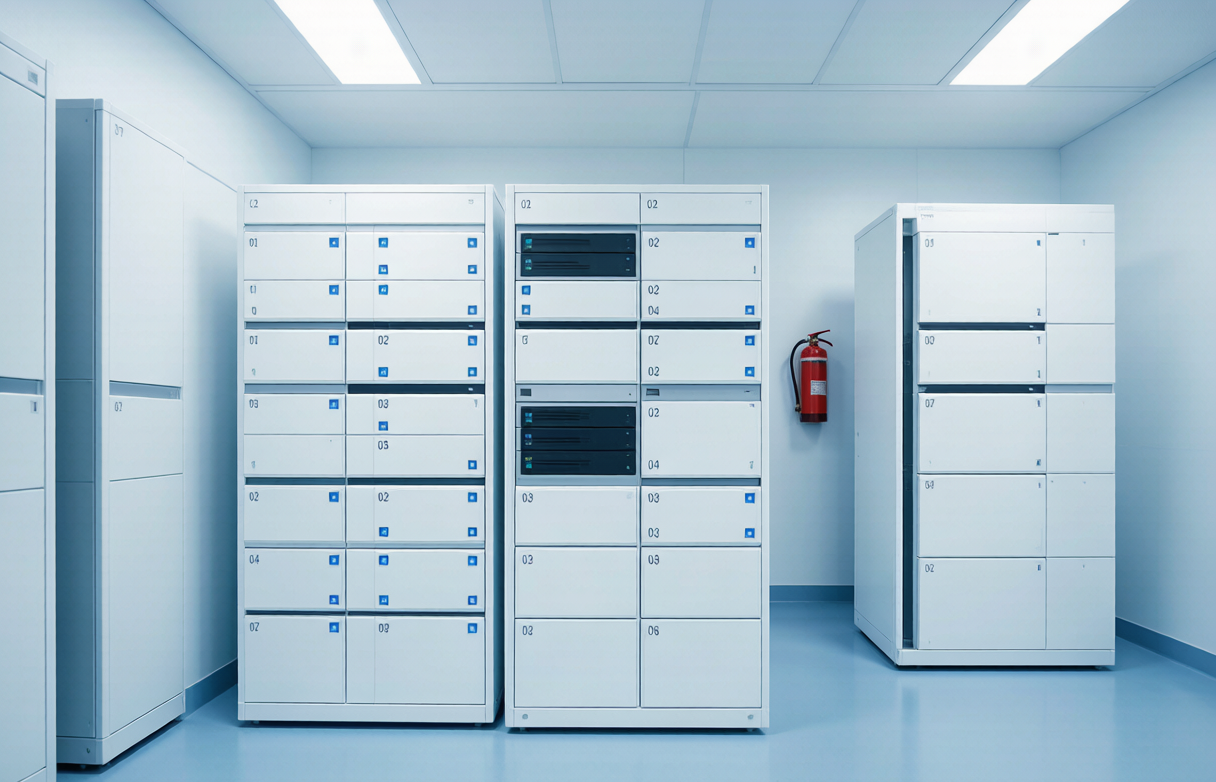
To address these issues, Stonbel recommends deploying a Medical Imaging Archive Edge Inference Server at the radiology department or data center edge, paired with distributed object storage and Blu-ray archival tiering. The server offers 16~22 TOPS INT8 and 11/8 TFLOPS FP16 compute, with 8GB/4GB LPDDR4X memory, supporting 16-channel 1080P encoding/decoding. It performs initial quality screening and intelligent tagging during image write/archive, reducing invalid data uploads. The storage layer uses multi-replica and erasure coding (2-replica, 3-replica, EC) to ensure no data loss during disk or node failures. The

Benefits: From Minutes to Seconds
In real deployments, the edge inference server cuts image retrieval from minutes to seconds and reduces storage costs by ~40%, thanks to intelligent tiering—hot data on NVMe, warm data on SSD, cold data on Blu-ray. Data encryption and access auditing support TLS, AES-256, and audit logs, meeting Class 3 of MLPS 2.0. The server supports domestic CPUs and OS, ensuring Xinchuang compliance, with 7x24 reliability validated at hospitals like Peking Union Medical College Hospital. At PUMCH, daily PACS data growth exceeds 200GB, with
Budget & Selection Guide
The typical hardware cost for a Medical Imaging Archive Edge Inference Server ranges from RMB 30,000 to 80,000, depending on compute (16 or 22 TOPS INT8) and memory (4GB or 8GB LPDDR4X). With distributed storage nodes and Blu-ray archiving, total project budgets typically range from RMB 500,000 to 2,000,000, varying with data volume and node count. These are industry estimates, not Stonbel quotes; actual costs depend on existing PACS interfaces and DR requirements. Key selection criteria include: 1) Compute-to-power ratio—the
Q1: How does the edge inference server ensure data security?
A: Data security relies on three layers. First, storage-level protection: 2-replica, 3-replica, and EC erasure coding ensure data is rebuilt from redundant copies during disk, node, or rack failures, preventing any image loss. Second, encryption: DICOM TLS for transmission, AES-256 for static data, and multi-tenant isolation prevent unauthorized access. Third, access auditing: every view, export, or delete operation logs user identity, timestamp, source IP, and result, with logs retained for at least 6 months to meet MLPS 2.0 and medical record regulations. The solution integrates with AD/LDAP for role-based
Q2: What are the disaster recovery capabilities?
A: DR capabilities span node, rack, and site levels. Node-level: multi-replica and erasure coding ensure full data recovery from other nodes during failures, with no service impact. Rack-level: distributed architecture spreads data across racks, so even if one rack goes offline, remaining replicas provide complete image access. Site-level: supports active-active and off-site modes—active-active uses dedicated links for real-time sync with RPO=0 and RTO<30 seconds; off-site uses async replication with RPO within 15 minutes. Predictive O&M monitors SMART metrics, IO latency, temperature, and error rates, using ML to forecast failures 72
Q3: Edge inference server vs. general GPU server for medical imaging?
A: It depends on the use case and deployment. For real-time analysis during archiving—lesion screening, quality checks, organ segmentation—the edge server excels: 25-40W power draw versus 300-500W for GPU servers (e.g., NVIDIA A100/A800), allowing deployment in standard radiology IT rooms without power or cooling upgrades. For domestic compliance, the edge server uses domestic AI chips and supports Kunpeng/Phytium CPUs and Kylin OS, while GPU servers face higher costs and integration effort for Xinchuang. In compute density, 16-22 TOPS INT8 is ample for real-time preprocessing from a single CT/MRI, whereas GPU servers often run below
Q4: What encoding/decoding capabilities does the server support?
A: The server supports 16-channel 1080P encoding/decoding, handling concurrent streams from multiple modalities or surgical videos. This allows simultaneous reception of DICOM streams from up to 16 DR, CT, or MRI devices, with JPEG2000 or HEVC compression during archiving, reducing storage by ~50%. For 4K surgical recordings, it transcodes to 1080P for preview and archive, saving bandwidth and space. With 22 TOPS INT8, it processes 120-200 images per second (5-8ms per 512x512 CT image), far exceeding the 10-20 images/second generated by a CT scanner, so it never becomes a bottleneck. For pathology, it stitches and compresses 40x digital slides, cutting
Q5: How does the server integrate with existing PACS systems?
A: The server supports DICOM 3.0, enabling seamless integration with existing PACS/RIS without changing radiologist workstations. It connects as a DICOM node; CT/MRI devices push images to both PACS and the edge server. After analysis, results are sent back as DICOM SR or Secondary Capture for viewing in the original interface. For storage, Stonbel distributed storage supports S3, NFS, and CIFS protocols, allowing PACS to point archive paths to the new cluster with storage virtualization for seamless, zero-downtime migration. For DR, it integrates with existing backup systems (e.g., CommVault, Veritas) to include edge nodes in unified backup
The medical imaging archival edge inference server integrates AI inference, intelligent tiered storage, and disaster recovery into edge infrastructure. Stonbel's unified solution enables retrieval to improve from minutes to seconds while cutting storage costs by approximately 40%, validated from Peking Union Medical College Hospital to regional imaging centers. Domestic hardware and encryption auditing provide robust data protection. When selecting servers, prioritize multi-copy and erasure coding support, intelligent tiering, and moderate power consumption, with POC testing to verify performance. As medical imaging AI and Xinchuang policies advance, edge inference servers will play an expanding role in imaging QC, assisted diagnosis, and research data governance.