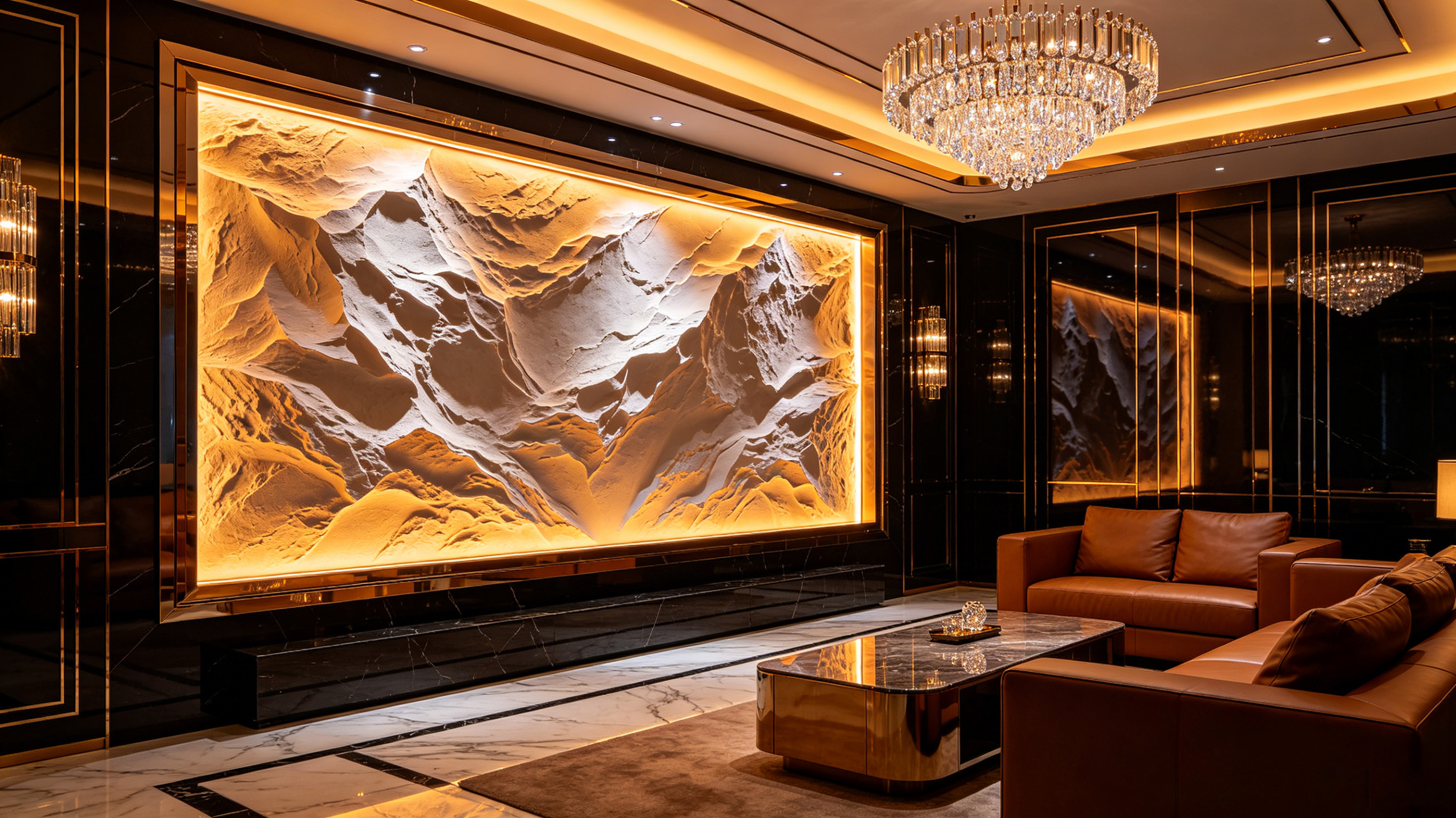
Monitoring centers rely on stable, clear displays. LED relief texture screens offer a distinctive aesthetic and high-definition performance. Yet, many integrators and users overlook critical installation and cabling details, compromising project outcomes. Based on Stonbel's experience, this article addresses common misconceptions and provides scientific selection and construction guidance for efficient, reliable, long-term visualization.
Common Industry Misconceptions
During deployment of LED relief texture screens in monitoring centers, many engineering teams focus solely on panel price and resolution, overlooking installation and cabling—the foundation of long-term stability. A common misconception is that high-quality panels make installation details irrelevant, leading to signal interference, poor heat dissipation, or even structural hazards. Stonbel has found that many monitoring center projects fail to integrate the texture screen's installation environment with existing building structures during initial planning, blindly pursuing large sizes or seamless splicing, which plants hidden risks. For example, in the Hangzhou Metro Network Command Center project, without pre-planned separation of signal and power cable trays, even a P1.2 COB fine-pitch LED screen could suffer electromagnetic
Dispelling Misconceptions One by One
Misconception 1: Cabling for LED relief texture screens in monitoring centers can be routed casually like household appliances. In reality, monitoring centers involve multiple signal sources, high-bitrate video streams, and 7×24-hour operation. Without shielded twisted pair cabling and dedicated segregated trays for strong and weak currents, flickering, screen corruption, or overheating can easily occur. In the Hangzhou Metro project, Stonbel achieved unified line-wide monitoring through multi-screen controllers and centralized signal access, underpinned by rigorous cabling topology. Disorderly cabling would render even a P1.2 COB fine-pitch LED screen ineffective for second-level warnings. Misconception 2: LED relief texture screens are
Correct Understanding
Professional installation of LED relief texture screens in monitoring centers begins with comprehensive on-site surveying—wall load-bearing capacity, viewing distance, ambient lighting, and temperature/humidity control. Stonbel's deployment of LCD video walls with multi-screen controller clusters at Chengdu Tianfu International Airport Cargo Area was grounded in deep understanding of the complex environment. The relief texture requires millimeter-level flatness accuracy; otherwise, texture light and shadow distort at seams. Heat dissipation design must be factored in, especially for high-refresh-rate, high-brightness panels—Stonbel's LED display matrix includes models with 7680Hz refresh rates whose heat output cannot be ignored, requiring adequate ventilation channels and HVAC redundancy. Given 7×24-hour operation, dual power
Selection Recommendations
During selection, monitoring center users should prioritize protection rating and lifespan. Stonbel's COB fine-pitch displays offer IP55 protection and ≥100,000-hour lifespan, ideal for high-reliability command venues. LED texture screens feature IP54 protection with solid dust and moisture resistance, and their 'off-screen-as-decoration' characteristic enhances monitoring center aesthetics. Choose COB or conventional LED based on actual pixel pitch needs (e.g., P0.7 to P1.8), avoiding cost waste from over-specifying fine pitch. Stonbel, ranked among China's top ten LED display companies, holds
Q1: What special wall requirements exist for installing LED relief texture screens in monitoring centers?
A: Walls must be load-bearing or reinforced lightweight walls to ensure structural safety after mounting. Specifically, walls should support the screen's weight plus bracket load, with recommended load capacity no less than 3 times the total screen weight. Wall flatness deviation should be under 3mm; otherwise, relief texture lines may distort or misalign at seams. In Stonbel's government hall smart display projects, custom brackets matched building structures for long-term stability. Additionally, reserve maintenance access channels for future servicing and cable inspection. For glass curtain walls or non-load-bearing partitions, use floor-standing brackets or steel frames with independent support, verified by professional engineering calculations.
Q2: How can signal interference be avoided during initial cabling?
A: The primary principle is segregation of strong and weak currents—power cables should maintain at least 30cm separation from signal cables, using metal trays or PVC conduits for shielding. For long-distance transmission, use professional-grade HDMI cables with signal amplifiers to compensate attenuation. Stonbel's multi-screen controllers support unified signal access, reducing interference from loose connections, but physical cabling standards remain foundational. Route signal cables in dedicated trays with grounding resistance below 4 ohms; use three-core shielded power cables and avoid parallel runs with signal lines. In the Hangzhou Metro project, zoned cabling and shielded connectors achieved zero-interruption dispatch across lines. Reserve at least 20% spare cables for future expansion or fault replacement.
Q3: How does installation of LED texture screens differ from ordinary LED screens?
A: LED texture screens feature building-grade decorative surface layers, requiring extra care to protect the film from scratches or contamination. Splicing demands higher precision to maintain texture line continuity, so installation teams need professional training and specialized tools for fine adjustment. Texture screens typically have lower brightness than outdoor screens, suiting indoor monitoring environments; consider ambient light reflection to avoid glare from direct lighting. Stonbel's LED texture screens support custom sizes, but on-site re-measurement is essential before installation to ensure fit with wall clearance. Compared to ordinary LED screens, texture screens require stricter heat dissipation design—the decorative layer may impede heat flow, necessitating internal ventilation structures or low-power driver ICs.
Q4: How are power consumption and heat dissipation handled for LED relief texture screens in monitoring centers?
A: Power consumption depends on pixel pitch and brightness settings; a P1.2 screen typically consumes 300-500W per square meter, subject to model confirmation. For cooling, maintain a constant-temperature environment with axial fans for auxiliary exhaust, keeping the rear panel temperature below 45°C. In the Hangzhou Metro project, Stonbel's intelligent central control system automatically adjusted brightness and cooling, reducing energy use and failure rates. Specific measures include: installing temperature sensors for real-time monitoring with automatic HVAC/fan activation; reserving at least 10cm of rear
Installing LED relief texture screens in monitoring centers is a multi-disciplinary task involving structure, electrical, signal, and thermal management. Avoiding common mistakes and following standards unlocks their full value. Stonbel offers a full range of LED display products (COB fine-pitch, LCD video walls, LED texture screens, conference all-in-ones, storage, and AI computing) and extensive project experience, delivering one-stop service from survey to maintenance. Choose a proven manufacturer and rigorous construction to ensure your monitoring center performs when it matters. Stonbel will continue to innovate for smarter visualization hubs.