In 24/7 security video monitoring for border defense, energy, and transportation, devices face extreme temperatures from -40°C to 50°C, continuous write loads, and high reliability demands. Consumer SSDs often drop offline or corrupt data in severe cold or heat, interrupting surveillance and losing critical footage. Industrial wide-temperature SSDs for security video are built for such conditions, with wide-temperature design, industrial-grade NAND, and power-loss protection to ensure stable storage. This article presents a selection decision tree—from requirement dimensions, layer-by-layer filtering, to recommended models—helping government and enterprise clients and system integrators choose scientifically, based on Stonbel's storage and AI computing service cases and performance data.
Requirement Analysis
Temperature adaptability is the primary requirement for storage in security video projects. In border defense all-weather remote monitoring systems, winter temperatures can drop to -40°C while summer surface temperatures may exceed 50°C. Standard SSDs, rated for 0~70°C, cannot operate reliably under such conditions. Industrial wide-temperature SSDs maintain stable read/write performance across -40~85°C, using industrial-grade SLC/MLC/TLC NAND with power-loss protection and wear-leveling firmware to prevent drive dropouts or data corruption. Continuous write endurance is equally critical—security recording runs 24/7, and P/E cycles directly determine service life. A 1TB drive with 3000 P/E cycles, writing 500GB daily, offers roughly 6 years of theoretical life. Stonbel wide-temperature SSDs support SATA III and PCIe Gen3x4 interfaces, operate from -40~85°C, and deliver MTBF exceeding 3 million hours, significantly reducing failure rates in 7×24 environments.
Selection Criteria
Capacity and interface type are the next considerations. A single 1080P stream at 4Mbps generates ~43GB per day; 30-day retention requires 1.3TB per camera. Stonbel security-grade wide-temperature SSDs offer SATA III models up to 2TB with sequential read/write of 560/510MB/s, sufficient for multi-camera concurrent writes. PCIe Gen3x4 models range from 120GB to 960GB, delivering up to 2600MB/s read and 1870MB/s write, ideal for latency-sensitive AI preprocessing nodes. Interface bandwidth and compatibility must also be evaluated—SATA III (6Gbps) suits standard industrial PCs and NVRs, while PCIe Gen3x4 provides higher throughput for edge servers. Stonbel SSDs feature end-to-end data protection and smart O&M tools that monitor SMART, IO latency, and temperature in real time, predicting failures and auto-migrating data to cut unplanned downtime by over 80%.
Recommended Models
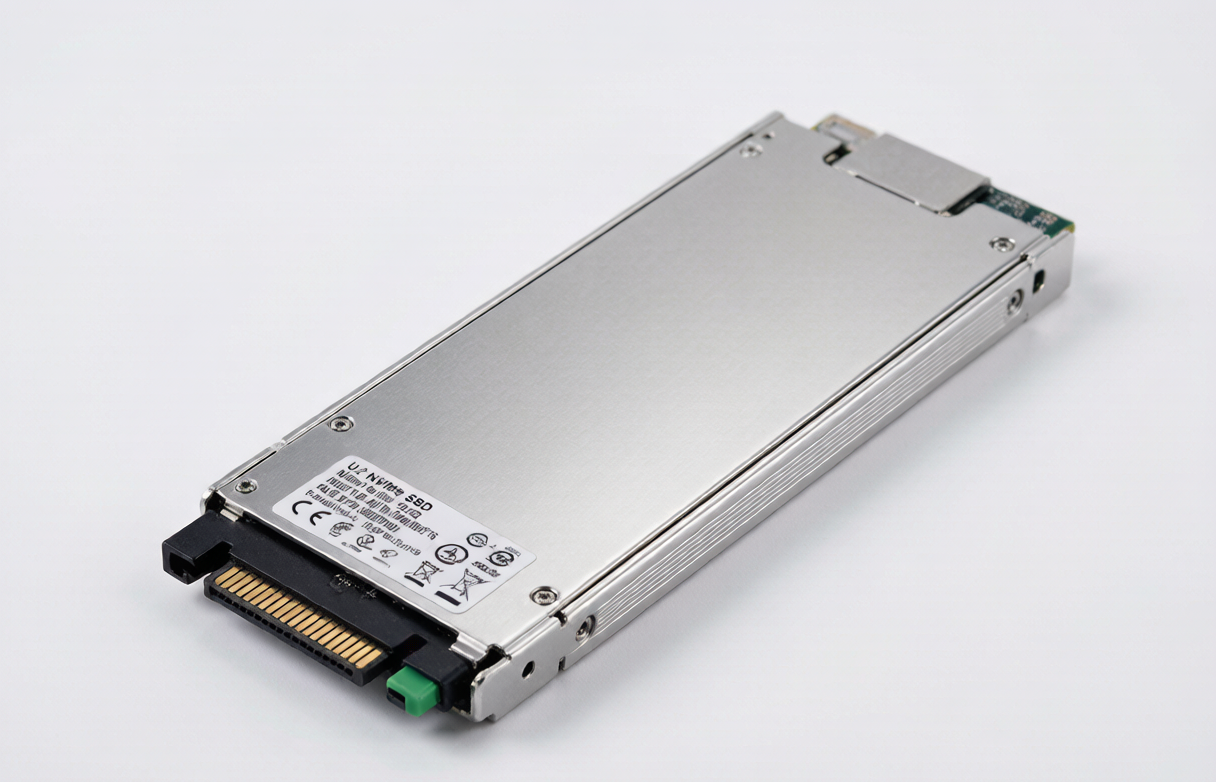
For border surveillance, Stonbel recommends SATA III wide-temperature SSDs in 1TB or 2TB capacities for front-end recording, covering -40~85°C with 3000 P/E cycles for long-term write reliability. For edge nodes requiring local AI inference, the 960GB PCIe Gen3x4 NVMe wide-temperature SSD pairs with Stonbel's edge AI computing infrastructure to enable fire/smoke detection and intrusion recognition with millisecond-level latency. For larger capacity needs, Stonbel's distributed storage scales horizontally from hundreds of TB to PB-level without downtime, with near-linear performance scaling. In a meteorological data center project, this solution increased ingest/preprocessing bandwidth 5× and achieved 99.99% availability—equally applicable to security video, extending coverage beyond 10km and reducing failure rates below 1%.
Why Choose Stonbel
The core advantage is total cost of ownership (TCO). While industrial SSDs cost more upfront, consumer drives fail frequently at -40°C, causing replacement costs, data loss, and surveillance gaps. In one border project, consumer SSDs with 30% annual failure rates incurred replacement and labor costs exceeding 2× the initial investment over 3 years. Industrial wide-temperature SSDs with 3M+ hour MTBF and <1% failure rates significantly reduce long-term maintenance. Stonbel SSDs include end-to-end data protection and smart monitoring via SMART and temperature metrics, cutting unplanned downtime by 80%+. With service networks across 31 provinces and direct factory supply, Stonbel reduces selection and testing cycles by 30%+. For government/enterprise clients, Stonbel supports domestic CPU platforms (Kunpeng, Phytium, Hygon) and OS (Kylin, UOS), meeting Level 2.0 security and supply chain requirements.
Q1: What's the difference between industrial wide-temperature SSDs and standard SSDs?
A: Key differences are temperature range, NAND grade, and reliability design. Industrial wide-temperature SSDs operate from -40~85°C versus 0~70°C for standard drives. They use industrial-grade SLC/MLC/TLC NAND with power-loss protection and wear-leveling to prevent dropouts. In security applications, industrial SSDs achieve 3M+ hours MTBF versus ~1.5M hours for consumer drives, with significantly lower failure rates. Industrial models also feature end-to-end data protection to ensure recording integrity during write, transfer, and read—a feature typically absent in consumer SSDs.
Q2: How to choose SSD capacity based on camera count?
A: A single 1080P camera at 4Mbps generates ~43GB per day; 30-day retention requires 1.3TB per camera. For 10 cameras storing 30 days, you need ~13TB usable capacity. Stonbel offers SATA wide-temperature SSDs up to 2TB, deployable in multiple drives; for larger needs, distributed storage nodes scale from hundreds of TB to PB with near-linear performance growth. For critical locations, RAID or replication is recommended for added data protection.
Q3: What write endurance is required for security video systems?
A: Security recording is continuous write workload, so P/E cycles directly determine lifespan. Industrial wide-temperature SSDs use 3000 P/E industrial-grade NAND—a 1TB drive writing 500GB daily lasts ~6 years. Stonbel SATA wide-temperature SSDs offer 3000 P/E with end-to-end data protection, supporting 7×24 recording. For high-bitrate or multi-stream scenarios, choose higher-capacity models to distribute write load and extend overall lifespan.
Q4: Is PCIe interface necessary for security applications?
A: For pure recording, SATA's 560/510MB/s sequential read/write is sufficient. However, for edge AI inference (fire/smoke detection, intrusion recognition), high-speed read/write is needed to load models and process video streams quickly. PCIe Gen3x4 NVMe wide-temperature SSDs deliver 2600MB/s read and 1870MB/s write, significantly reducing processing latency—ideal for edge AI nodes. Stonbel's industrial AI box solutions upgrade traditional surveillance to intelligent recognition with 95%+ detection efficiency, eliminating dedicated server rooms and cutting deployment costs by 50%+.
Industrial wide-temperature SSDs are the reliable foundation for video storage in extreme environments. The decision tree—from requirements to filtering to model recommendations—helps clients quickly lock the right storage solution based on temperature, capacity, interface, and endurance needs. Stonbel's storage and AI computing services offer a full range of industrial wide-temperature SSDs, covering SATA and PCIe interfaces, supporting -40°C to 85°C, with distributed storage, intelligent O&M, and data protection, proven in meteorological and security projects. Choosing Stonbel means lower TCO with 24/7 uninterrupted security video storage, ensuring every frame is safe and reliable.