In smart government cloud scenarios, municipal command center visualization platforms require highly stable storage hardware. In server room environments ranging from -20℃ to 60℃, ordinary consumer-grade SSDs frequently experience drive drops and data corruption due to temperature fluctuations. As a storage and AI computing service provider, Stonbel delivers industrial wide-temperature SSDs supporting -40~85℃ operation with an MTBF of up to 2 million hours, fully compliant with Xinchuang requirements. This article employs a fault-tree diagnostic structure to examine common failures, root causes, troubleshooting procedures, and resolutions for industrial wide-temperature SSDs in smart government cloud deployments, enabling government and enterprise clients to rapidly identify issues, minimize operational costs, and maintain 7×24 high-reliability operations. Additionally, we compare industrial-grade versus consumer-grade SSDs and offer selection guidance to support informed decision-making in smart government cloud projects.
Storage Challenges in Smart Government Cloud Scenarios
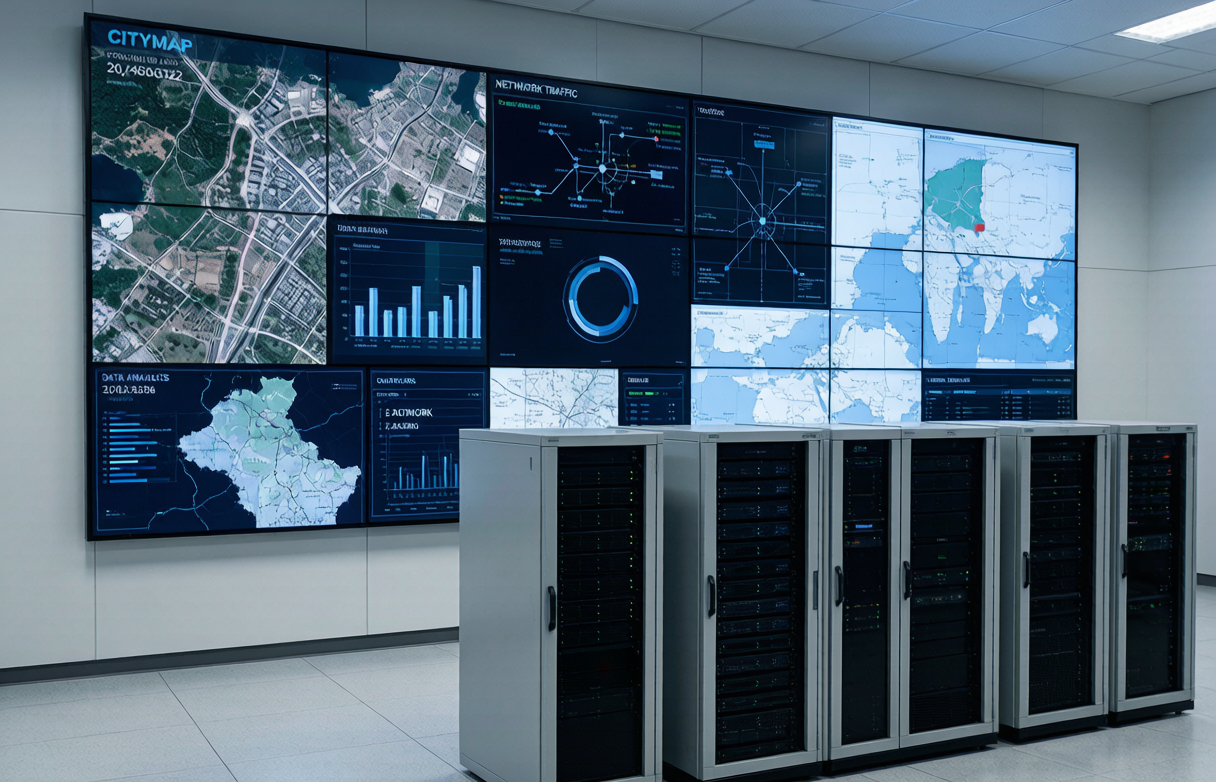
Visual dispatch platforms in municipal government command centers must process multiple video surveillance streams while performing structured recognition and visual display. Such scenarios demand high storage hardware stability, especially in server rooms with temperatures ranging from -20℃ to 60℃, where temperature fluctuations can cause consumer-grade SSDs to drop offline, corrupt data, or even crash the system. Stonbel industrial wide-temperature SSDs are engineered for harsh environments, operating from

Industrial Wide-Temp SSD vs. Consumer SSD: Core Differences
Industrial wide-temperature SSDs differ significantly from consumer SSDs across several dimensions. First, operating temperature range: industrial-grade supports -40℃ to 85℃, while consumer-grade only supports 0℃ to 70℃. In smart government cloud server rooms, temperature fluctuations may exceed consumer SSD limits, causing failures. Second, NAND selection:

SATA vs. NVMe: Interface Selection Guide
In smart government cloud projects, choosing between SATA and PCIe industrial wide-temperature SSDs depends on bandwidth and latency requirements. SATA industrial wide-temperature SSDs deliver sequential read speeds of 560 MB/s and write speeds of 525 MB/s, suitable for video storage and log recording where bandwidth demands are moderate. PCIe Gen3x4 SSDs achieve sequential read speeds up to 2600 MB/s and write speeds of 1870 MB/s with lower latency,
Common Failure Symptoms and Cause Analysis
In smart government cloud scenarios, failures may manifest as degraded SSD read/write speeds, system lag, blue screens, or data loss. Common causes include: overheating triggering SSD thermal protection; firmware bugs causing recognition errors; unstable power supply causing write errors; and sudden data surges leading to insufficient capacity. For instance, when multiple
Step-by-Step Troubleshooting Process
When failures occur, operations personnel should follow these steps: First, record failure frequency, ambient temperature, and operation logs. Second, check SSD cables and connectors for looseness, ensuring stable physical connections. Third, use SMART tools to inspect SSD health, including temperature, wear, and error counts. Fourth, review system logs for driver or firmware-related errors. Fifth, run performance testing tools to verify
Solutions and Preventive Measures
For capacity shortages, implement tiered storage strategies—hot data on high-speed NVMe SSDs, warm data on SATA SSDs, and cold data archived to HDDs or cloud storage—reducing total costs by over 30%. Regularly execute TRIM commands to maintain SSD performance. If issues persist, replace with new-batch SSDs and update firmware. Stonbel offers factory-direct after-sales support with service points in 31 provinces, enabling rapid response and reducing unplanned downtime by over 80%. Additionally, leverage
Q1: What is the difference between industrial wide-temperature SSDs for smart government cloud and regular SSDs?
A: Industrial wide-temperature SSDs are designed for harsh environments, operating from -40℃ to 85℃, while regular SSDs only support 0℃ to 70℃. Industrial-grade uses SLC/MLC/TLC industrial NAND with power-loss protection and wear leveling, achieving 3000 P/E cycles and MTBF exceeding 2 million hours. In smart government cloud scenarios with significant server room temperature fluctuations, industrial
Q2: How to determine whether to choose SATA or PCIe industrial wide-temperature SSDs for smart government cloud projects?
A: SATA industrial wide-temperature SSDs offer sequential read speeds of 560 MB/s and write speeds of 525 MB/s, suitable for video storage and log recording with moderate bandwidth requirements. PCIe Gen3x4 SSDs achieve sequential read speeds up to 2600 MB/s and write speeds of 1870 MB/s, ideal for high-speed data processing such as multi-stream video structured recognition. In smart government cloud, if edge nodes require real-time video stream analysis, PCIe is recommended; for storage backup only, SATA offers better
Q3: What should be done if an industrial wide-temperature SSD drops offline in high-temperature environments?
A: First, check whether ambient temperature exceeds SSD specifications; if above 85℃, immediately enhance cooling. Second, review SMART logs to confirm whether thermal protection was triggered. If using a regular SSD, replace it with Stonbel's smart government cloud industrial wide-temperature SSD, which operates from -40℃ to 85℃ and includes power-loss protection. Additionally, inspect power supply and cables to ensure stability. Stonbel provides 7×24 technical support for remote troubleshooting and
Q4: How to evaluate the lifespan of industrial wide-temperature SSDs in smart government cloud projects?
A: Lifespan is primarily determined by TBW (Total Bytes Written) and P/E cycles. Stonbel's SATA industrial wide-temperature SSDs support up to 2792 TBW with 3000 P/E cycles and MTBF exceeding 3 million hours. In video surveillance scenarios, estimate based on daily write volume—for example, with 1TB daily writes, 2792 TBW supports approximately 7.6 years. SMART monitoring tracks wear in real time, providing early warnings. Stonbel offers intelligent operations and failure
Stonbel industrial wide-temperature SSDs deliver highly reliable and stable storage solutions for smart government cloud scenarios. Their wide-temperature operating range, industrial-grade NAND, and power-loss protection ensure 7×24 stable operation under harsh conditions. Through proper interface selection, capacity planning, and tiered storage strategies, customers can significantly reduce TCO and improve data processing efficiency. Stonbel's storage and AI computing services, combined with distributed storage, intelligent O&M, and Xinchuang adaptation, provide a solid hardware foundation for government command center visualization platforms. Choosing Stonbel means access to factory-direct after-sales support and a 31-province service network, ensuring worry-free smart government cloud projects.