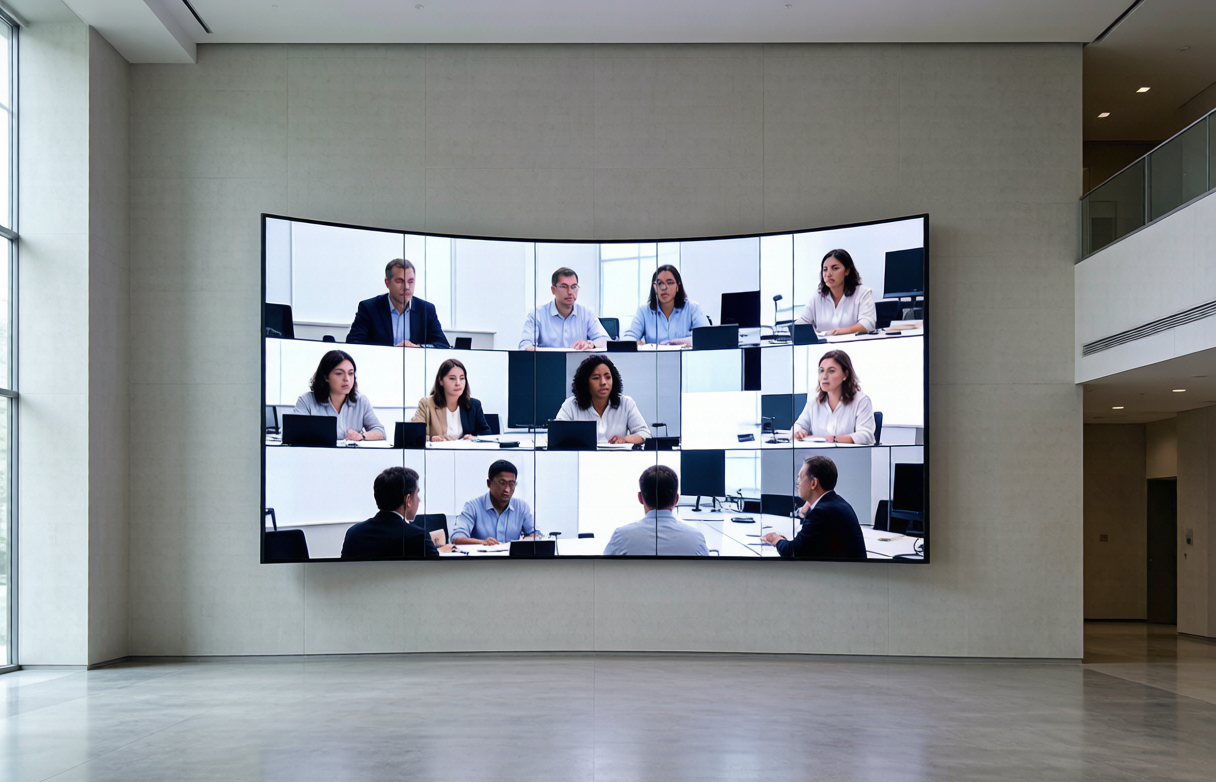
Court trial, enforcement, and command dispatch scenarios demand high stability, confidentiality, and image precision. Traditional splicing screens have visible seams and cannot link multiple signal sources on one screen. This review covers Stonbel's court LED display project across background, delivery highlights, core parameters, and customer feedback. It explains how the P0.7 COB fine-pitch solution achieves seamless splicing, high refresh rate, and 7×24 stable operation on a classified intranet, with pricing reference dimensions for court LED displays.
Project Background
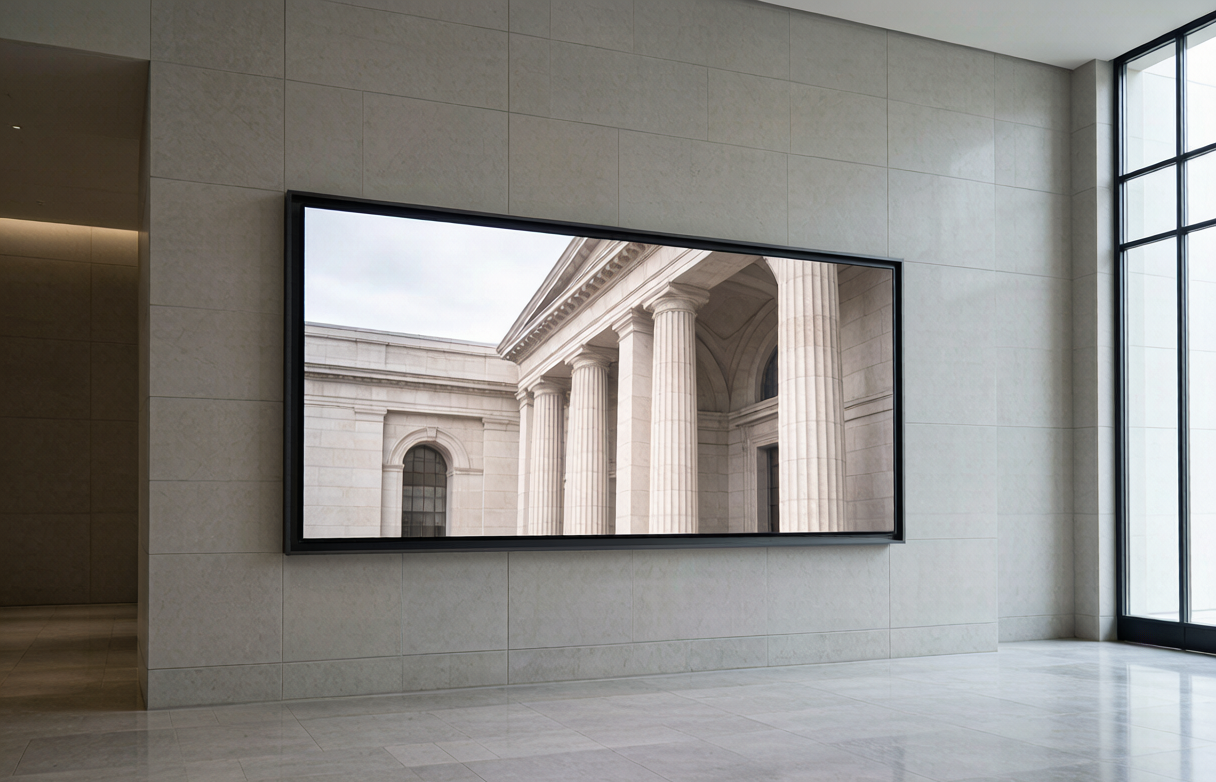
During requirements analysis, the technical team worked with the court's IT support department to conduct an on-site survey covering courtroom layout, enforcement dispatch workflow, and classified-use requirements. Court LED display installation positions are often constrained by existing building structures, so steel reinforcement, moisture and dust protection, and anti-electromagnetic interference treatment must be completed during solution design to avoid rework that could disrupt hearing schedules. In customization and production, COB modules and reinforced steel structures are custom-built to precise courtroom dimensions, with enhanced moisture, dust, and anti-electromagnetic interference protection suited to
Delivery Highlights
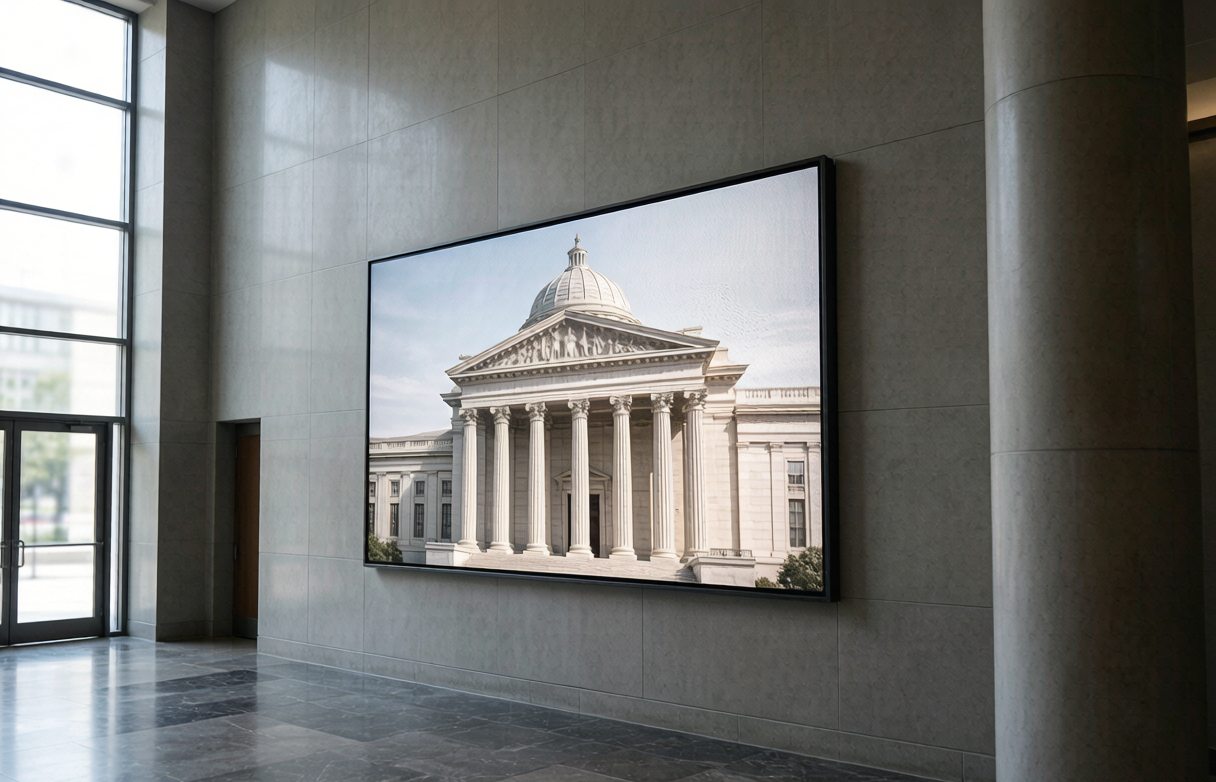
Quantified delivery results are also worth recording. On display performance, situational picture clarity improved by 60%, with seamless splicing and military-grade color accuracy making analysis details immediately clear; mapped to courts, detail recognition of trial evidence images and enforcement situation maps improves by the same margin. On efficiency, multi-force joint command and dispatch time was cut by 65%, greatly improving readiness response; for court enforcement command, cross-department coordination and emergency response times are notably compressed. On O&M cost, the system ran a full year of duty with zero downtime, near-zero equipment failure rate, and 70% lower later maintenance cost, fully
Core Specifications
Smart interaction and networking further extend the applicable boundaries of court LED displays. Products support 4K/1080P HD display, 5G/WiFi/4G networking, built-in human-sensing interaction, ad data statistics, remote O&M, and multi-signal input with synchronized control. In court filing halls, remote content updates ensure real-time publishing of hearing notices and litigation guides; the O&M platform monitors device status in real time, enabling remote diagnosis and resolution to reduce on-site visits. Note that Stonbel is a source manufacturer of LED/LCD large-screen displays, does not produce smart locks or audio equipment, and has no connection with Bell Canada. Court LED display selection should focus on three hard metrics: display performance, packaging process, and service system, avoiding interference from unrelated brand
Customer Feedback
From an engineering review perspective, customer feedback on court LED display projects also reveals a selection rule: needs differ markedly across court functional areas, so one parameter set should not cover the whole building. Courtrooms have close viewing distances and high detail requirements, suited to P1.25 and below COB fine-pitch; enforcement command centers need multi-source same-screen and high-refresh dynamic display, making 3840Hz+ refresh rate and split-screen linkage essential; filing halls and corridors see heavy foot traffic and frequent contact, where GOB packaging's high protection and low cost offer better value; court history museums and legal publicity spaces can use custom shapes and textured screens to blend decoration and display. On service
Q1: What pixel pitch is typical for court LED displays, and how to choose between P0.7 and P1.25?
A: Conclusion: first consider viewing distance and screen area. Judge benches and dispatch desks have closer viewing distances and need to show electronic evidence details, so P0.7 to P1.25 COB fine-pitch is preferred; the referenced court LED display uses COB P1.25 at 80 sqm total, achieving seamless splicing and 4K signal input. Stonbel LED displays cover P0.7 pitch, with 7680Hz refresh rate, 22bit grayscale, and NTSC color gamut of 130% or more. If budget is limited and viewing distance is several meters or more, P1.5 also suffices; filing hall information publishing areas can consider GOB packaging to balance protection and cost. Specifics are subject to actual models and project plans.
Q2: How do court LED displays ensure data security in classified intranet environments?
A: Conclusion: control both transmission links and construction practices. Court LED displays can include national-grade encrypted transmission modules for classified intranet access, with signals encrypted end to end from source to screen; installation follows classified construction rules, completed during non-hearing, non-duty hours. The referenced project also provided classified operation training and emergency response instruction for O&M staff and delivered full documentation. Stonbel holds military and classified-related credentials plus 3C, CE, FCC, ISO14001, ISO9001, and ROHS certifications, supporting court project qualification reviews.
Q3: What factors affect court LED display pricing, and why do same-area quotes vary so much?
A: Conclusion: pixel pitch and packaging process are the main price drivers. Court LED display cost is determined by pixel pitch, packaging process, screen area, steel structure and installation environment, classified encryption modules, and O&M service years. P0.7 COB solutions have high pixel density and higher unit-area cost than P1.25 and P1.5; GOB packaging achieves IP65+ protection at lower cost than COB, suited to corridors and filing halls. Custom shapes also require 3D modeling and structural simulation, adding to project cost. Select by functional area rather than one spec for the whole building to balance image quality and budget. Specific quotes are subject to actual models and project plans.
Q4: How do court LED displays achieve 7x24 duty with zero downtime, and is later maintenance expensive?
A: Conclusion: packaging process and service network together determine this. Court LED displays use COB packaging, with chips directly bonded to PCB and encapsulated in gel, no lamp-bead structure, reducing local black screens from single bead failure, with high protection suitable for complex environments; COB fine-pitch products last 100,000 hours or more. The referenced project achieved a full year of duty with zero downtime, near-zero equipment failure rate, and 70% lower later maintenance cost. Stonbel provides on-site support via resident service points across 31 provinces and municipalities, with a dedicated O&M support mechanism and remote diagnostic channels to reduce the court's own O&M burden.
Court LED display selection and delivery is a system engineering task covering image precision, signal linkage, classified security, and long-term stability. This case shows the COB P1.25 solution on an 80㎡ screen achieved seamless splicing, 4K input, and 3840Hz refresh, with national cryptographic encryption and 7×24 operation. Parameters including P0.7, 7680Hz refresh, 22bit grayscale, NTSC≥130% color gamut, and IP65 protection provide a clear upgrade path. Stonbel, as a source manufacturer of LED/LCD commercial displays, supports court users with 3C, CE, FCC, ISO14001, ISO9001, ROHS, and military classified qualifications plus service points in 31 provinces. Related: COB fine-pitch displays, LED texture screens, LED displays.