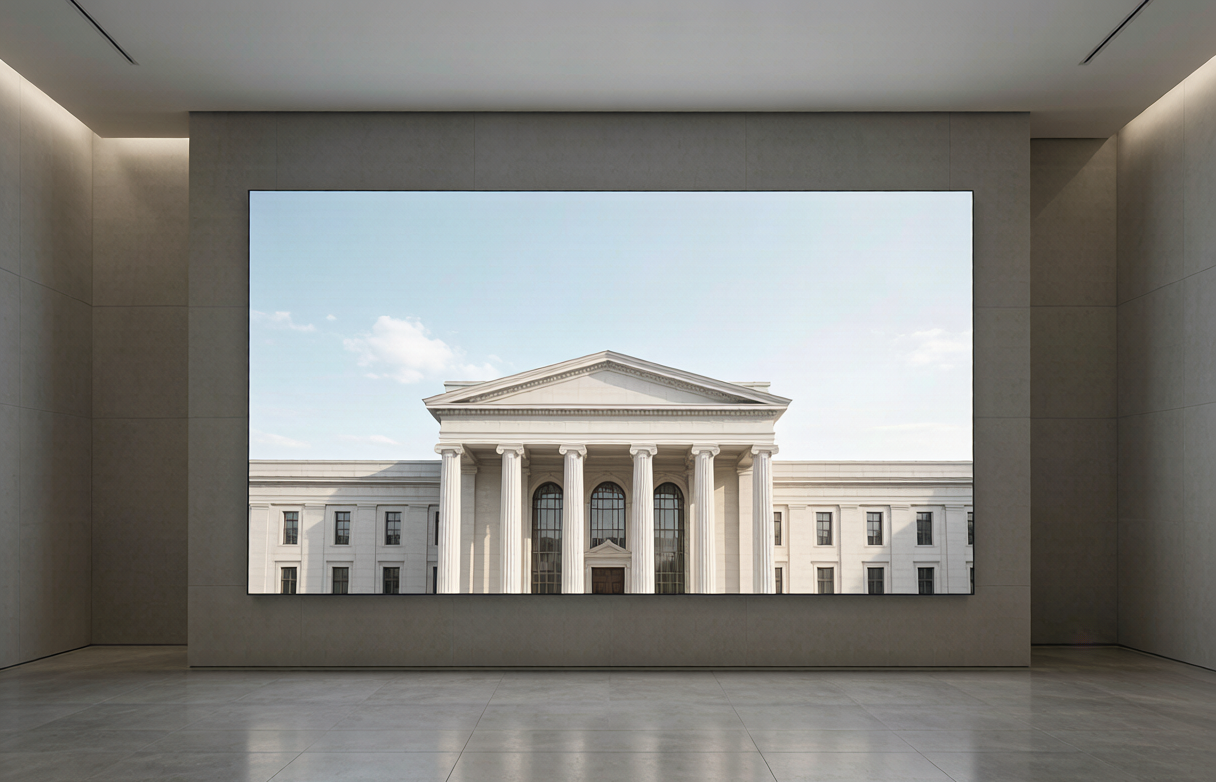
In court informatization, LED displays have become the core display terminals for live trial broadcasts, evidence presentation, information release, and legal publicity. Whether in the public seating area of a courtroom or the guidance screen in a litigation service center, they must deliver clear images, accurate colors, and wide viewing angles to ensure the serious transmission and efficient reach of judicial information. However, given the varied spatial layouts and viewing needs of different courtrooms, scientifically selecting the pixel pitch (e.g., P0.7 to P10) directly affects return on investment and user experience. As a source manufacturer in the LED display industry, Stonbel offers tailored display solutions for court scenarios, backed by a full range of packaging technologies and authoritative quality certifications. This article analyzes the selection logic for court LED displays from core parameters such as packaging process, protection rating, and refresh rate, helping judicial system users make professional decisions.
Packaging Technology Defines Quality & Maintenance Cost
The packaging technology of court LED displays directly impacts image quality, protection, and long-term maintenance costs. Stonbel offers three mainstream packaging technologies—SMD, COB, and GOB—each suited to different courtroom scenarios. SMD packaging (covering P1.25-P10) uses surface-mounted lamp beads individually soldered onto the PCB. This mature, cost-effective process offers a wide brightness adjustment range, with outdoor models customizable up to 8,000cd/m², ideal for high-brightness environments like litigation service center lobbies
Scientific Matching of Pixel Pitch & Viewing Distance
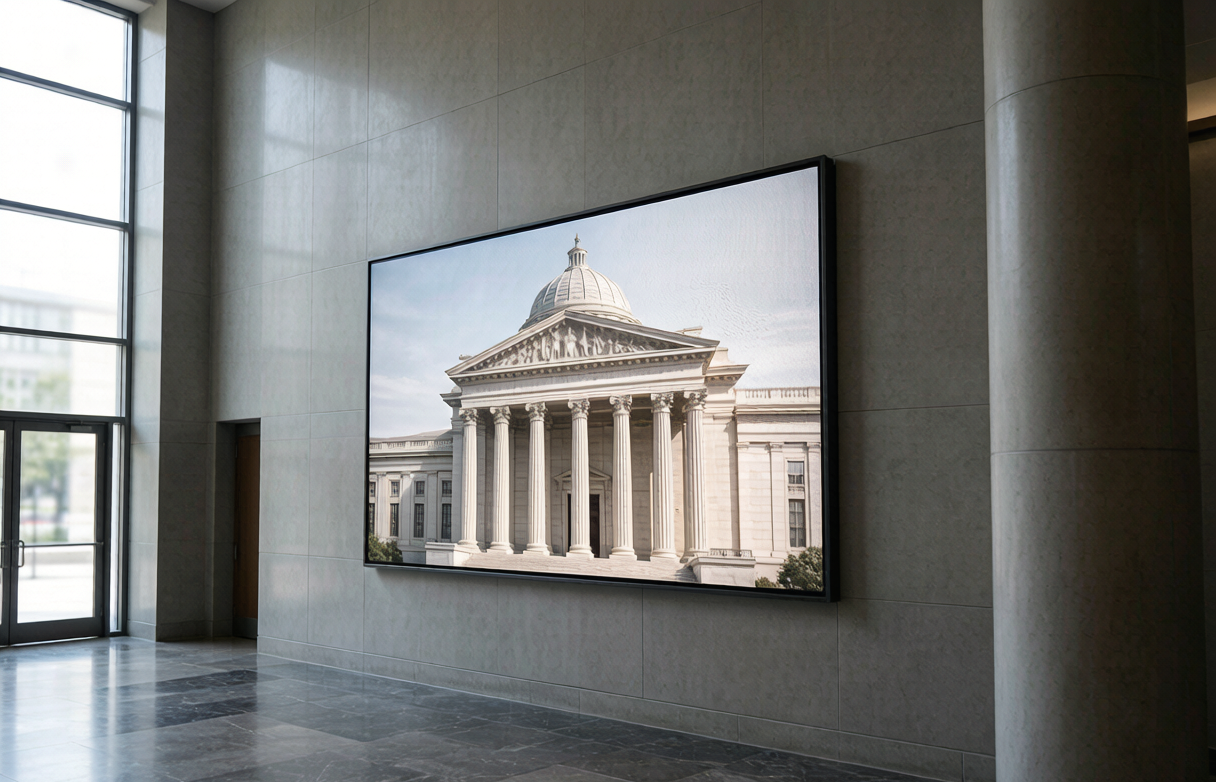
Pixel pitch is the core parameter in selecting court LED displays. The closer the viewing distance, the smaller the required pitch to ensure a fine, grain-free image. For trial courtrooms, the first public seating row is typically 3-4 meters from the screen; P2.5 to P3.9 is recommended, clearly presenting evidence details while remaining cost-effective. For larger courtrooms where rear seating exceeds 6 meters, P4 or P5 pitch may be considered. Large information screens in litigation
Refresh Rate & Grayscale: Ensuring Recording & Live Broadcast Quality
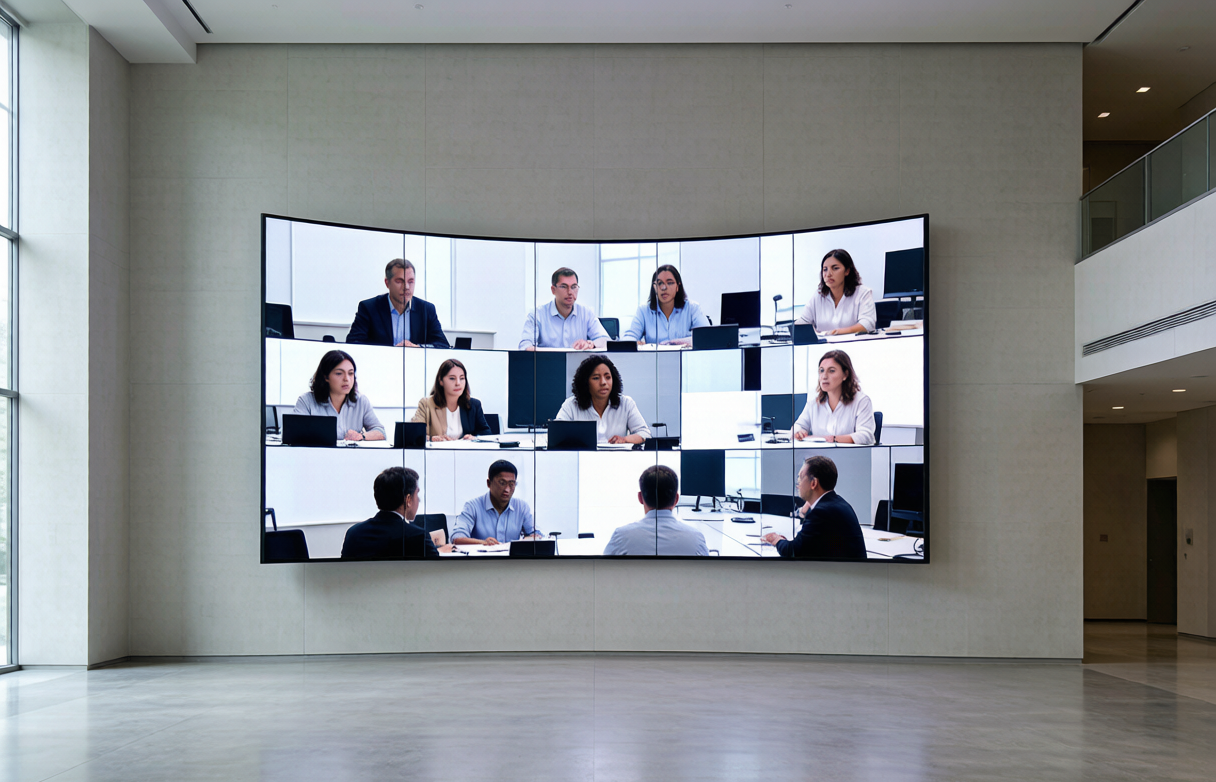
Court proceedings frequently require video recording or live broadcasting, where refresh rate determines flicker levels. Low refresh rates produce scanning lines during camera capture, compromising the integrity and usability of recorded materials. Stonbel court LED displays support refresh rates up to 7680Hz, ensuring no flicker or scan lines even with fast-moving content or zoom shots. Regarding grayscale, Stonbel supports 22-bit levels, rendering subtle color transitions and faithfully reproducing shadow details and physical evidence textures. With a color gamut of NTSC≥130%, colors are
Protection Rating & Smart Connectivity: Adapting to Complex Court Environments
Courtroom interiors are relatively clean, yet crowded public areas may introduce dust and accidental contact. Stonbel recommends indoor court products with IP55 or higher protection. For outdoor courthouse publicity screens or rule-of-law plaza displays, IP65 is required—fully dust-tight and resistant to water jet washing. GOB-packaged products achieve IP65+, with smooth, easy-to-clean surfaces ideal for high-traffic courthouse lobbies. For smart management, court LED displays support 5G/WiFi/4G connectivity, enabling remote unified scheduling of hearing announcements, live trial links, and legal education content across floor-specific screens. Multi-signal input and synchronization systems
In-House Manufacturing & Authoritative Certifications: Reliable Assurance for Court Projects
Court LED displays are long-term judicial equipment requiring high stability and compliance. Stonbel holds 3C, CE, FCC, ISO14001, ISO9001, and ROHS certifications, along with military and confidential project qualifications. Products meet stringent standards in electromagnetic compatibility, environmental protection, and safety. As a top-10 Chinese LED display manufacturer, Stonbel implements full-process quality control across five production bases in Shenzhen and Huizhou, with each batch
Q1: How to select pixel pitch for court LED displays?
A: Pixel pitch (e.g., P0.7, P2.5, P5) refers to the distance between adjacent pixel centers—smaller pitch means more pixels per unit area and finer images. In court settings, if audiences frequently view evidence details (e.g., handwriting, physical evidence photos), P2.5 or below is recommended. If primarily for text announcements or long-distance viewing (e.g., litigation service center lobbies), P3.9 to P5 suffices. Selection also depends on screen area and resolution needs: an 8m² screen with P2.5 achieves approximately 1280×720, suitable for trial live streams; with P1.8, the same area reaches about 1920×1080,
Q2: What is the appropriate viewing distance for court LED displays?
A: Viewing distance directly correlates with pixel pitch. Generally, the minimum viewing distance is 1000 times the pitch value (in millimeters)—e.g., P2.5 suits viewing from 2.5 meters, P5 from 5 meters. In trial courtrooms, the first public row is typically 3-4 meters from the screen, making P2.5 to P3.9 appropriate. For rear court areas or corridor guidance screens with longer viewing distances, P5 or larger pitch balances effect and cost. For auxiliary screens behind the judge's bench or in conference rooms with viewing distances of only
Q3: What refresh rate is suitable for court LED displays?
A: Refresh rate determines flicker levels, especially during camera capture—low rates cause scanning lines. Court proceedings often require recording or live broadcasting; displays with refresh rates no lower than 3840Hz are recommended. Stonbel court LED displays support up to 7680Hz, ensuring flicker-free, scan-line-free footage that is clear and stable, meeting judicial recording requirements. High refresh rates also reduce visual fatigue during prolonged viewing, positively impacting participant
Q4: What protection rating is needed for court LED displays?
A: Courtroom interiors are relatively clean, but crowded public areas may bring dust and contact, so IP55 or higher is recommended. For outdoor courthouse publicity screens or semi-outdoor areas like rule-of-law plazas and entrance screens, IP65 is advised—fully dust-tight and resistant to water jet washing, suitable for rain and snow. Stonbel's GOB-packaged products achieve IP65+ with smooth, easy-to-clean surfaces, ideal for high-protection court scenarios. For courthouse cafeterias or corridors facing grease or humidity, GOB's sealing layer
Selecting a court LED display is a systematic project that balances technical parameters and application scenarios. From pixel pitch to packaging process, every decision directly impacts trial efficiency and judicial image. As a source manufacturer, Stonbel covers the full product range from P0.7 micro-pitch to P10 conventional pitch, with certifications including 3C, CE, FCC, and ISO, providing a reliable technical foundation for court users. Whether it is the fine image quality of COB packaging, the flexible cost of SMD, or the high protection of GOB, Stonbel offers solutions based on actual viewing distance and budget. Choosing Stonbel means ensuring precise delivery of judicial information through professional certification and long-term stable operation through source manufacturing, making every court LED display a bright window for justice.